
Overview
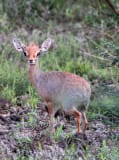
It is a subspecies of salt dik-dik, and salt dik-diks are somewhat larger than the other short-snouted races, but have slightly smaller horns. The Harar dik-dik is about the same size as the Swayne and Phillips dik-diks. It has the reddest coloration of all dik-diks. In the eastern part of its range, the flanks and shoulder patches are bright reddish brown (much darker than the pale orange flares of the Phillips dik-dik), contrasting sharply with the grizzled gray of the cheeks, neck and rump. The reddish color spreads across the back to give it a grizzled ginger coloration. In the western part of its range it loses the contrast, becoming browner overall. The top of the face, the head tuft and the legs are reddish. The underparts are white.
Taxonomy
- Kingdom
- Animalia
- Phylum
- Chordata
- Class
- Mammal
- Order
- Artiodactyla
- Family
- Bovidae
- Genus
- Madoqua
- Species
- saltiana
Habitat
Arid bush and semidesert thickets. Distribution- South of the Chercher Mountains in Ethiopia, extending from the Webi Shebeli River eastward to the Somali border, and into northwestern Somalia perhaps as far as the Golis Mountains. The extent of its range in the Ogaden region south and southeast of the Chercher Mountains is not known.
Diet
This animal both grazes and browses, based on seasonal availability.
Behavior
Dik-diks have well-developed sight, scent, and hearing. When dik-diks feel they’re in danger or hear the alarm calls from other animals, they hide instead of fleeing from predators. And when frightened or disturbed, dik-diks make a whistling sound through the nose that sounds like “zik-zik,” and this is probably how they got their name. Dik-diks mate for life and live together in low bush areas along dry, rocky stream beds. They are rarely seen apart from their partners. Mostly nocturnal, dik-diks avoid the heat of day; this also helps them prevent unnecessary water loss.
Hunting
Mainly spot and stalk methods. Often a high caliber solid bullet is prefered due to its passing through without expansion, causing little damage to the meat and hyde. Often taken as a chance occurance while pursuing other species.
Conservation Status
Listed as Least Concern by IUCN.