
Overview
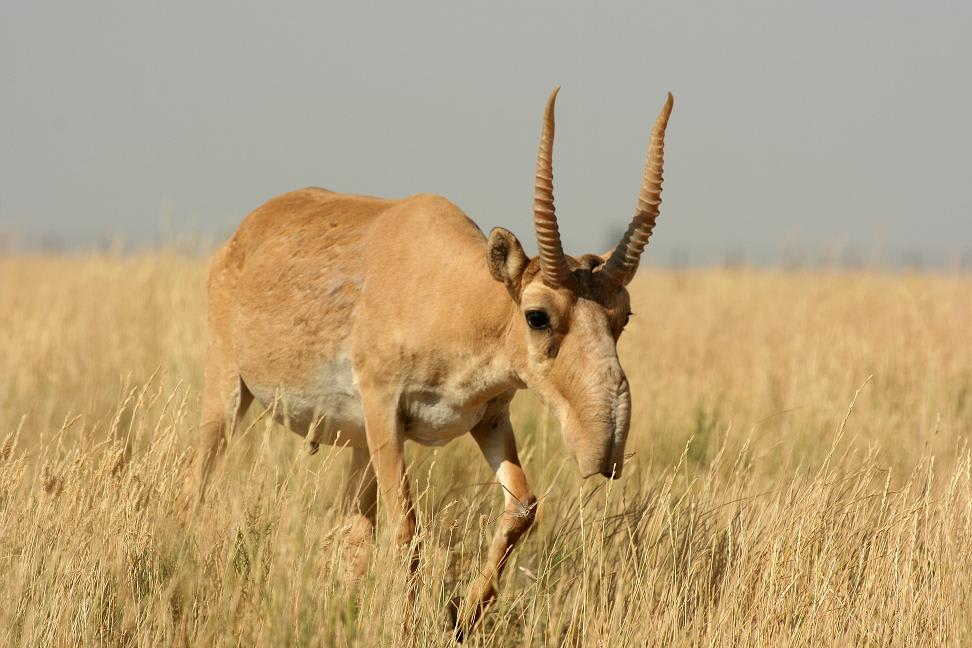
A rather odd-looking animal, short and a little heavy in proportion to its length, with a remarkable swollen nose. The head is carried low with the neck extended forward. The heavy coat is cinnamon-tan in summer, with underparts, rump and tail white, becoming uniformly whitish in winter. The proboscis-like nose has downward-pointing nostrils, each containing a sac lined with mucous membranes (a feature it shares only with whales) and a complex bone structure. It is believed the specialized proboscis may be designed to warm and moisten inhaled air. The horns (males only) are short, ringed, somewhat lyrate and pale amber in color, becoming almost translucent at the tips. (The horns are in demand in the Chinese pharmaceutical trade for use in folk medicine.) Longest recorded horns (Rowland Ward, 1980) are 16-1/4 inches (41.3 cm).
Taxonomy
- Kingdom
- Animalia
- Phylum
- Chordata
- Class
- Mammal
- Order
- Artiodactyla
- Family
- Bovidae
- Genus
- Saiga
- Species
- Saiga tatarica
Habitat
Grassy plains and semi-deserts. May enter open forest in summer. Distribution- Its Asian distribution extends from the lower Ural River in Kazakhstan eastward to western Junggar Pendi (Dzungarian Basin) in the Xinjiang region of China. Also introduced on the islands of Bulla and Glinyany in the Caspian Sea. Extends into Europe from the Ural River, which is the boundary between Europe and Asia, westward through the Kalmyk Republic of the Russian Federation.
Diet
Feeds mainly on grasses but also on shrubs and herbs. Drinks water twice daily in summer.
Behavior
A herd animal that wanders throughout the day with no fixed home range. Some populations make extensive seasonal migrations, with herds numbering in the hundreds of thousands and traveling as far as 50-75 miles (80-120 km) a day. Herds break up into groups of 30-40 on summer range, again forming large migratory herds in the fall. Males are highly aggressive during the rut, fighting fiercely-often to the death-and gathering harems of 5-15 females. Following the rut, exhausted males often die in large numbers. Mating season is December-January, with calves (usually twins, otherwise one) born April-May. Full grown at 20-24 months, but able to mate sooner-females before their first birthday. Able to run 50 mph (80 kmh). Newborn calves can outrun humans by the second day of life. Leaps and swims well. Sense of smell is exceptional, vision is excellent but hearing is poor.
Hunting
No legal hunting currently.
Conservation Status
Listed as Critically Endagneded by IUCN. Extinct in native ranges of China, Mongolia, Ukraine.