
Overview
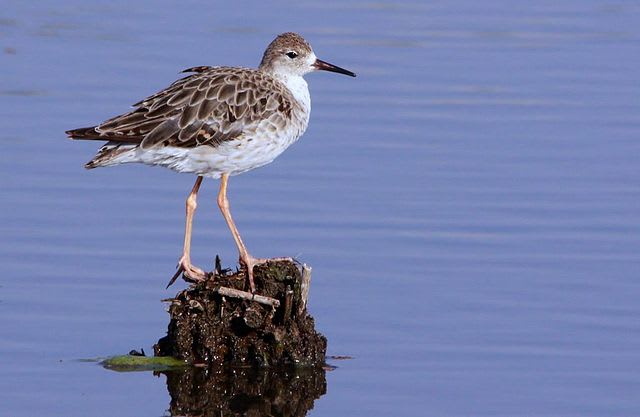
The ruff has a distinctive gravy boat appearance, with a small head, medium-length bill, longish neck and pot-bellied body. It has long legs that are variable in colour but usually yellow or orange. In flight, it has a deeper, slower wing stroke than other waders of a similar size, and displays a thin, indistinct white bar on the wing, and white ovals on the sides of the tail. This species shows sexual dimorphism. Although a small percentage of males resemble females, the typical male is much larger than the female and has an elaborate breeding plumage. In the May-to-June breeding season, the typical male's legs, bill and warty bare facial skin are orange, and he has distinctive head tufts and a neck ruff. These ornaments vary on individual birds, being black, chestnut or white, with the colouring solid, barred or irregular. The grey-brown back has a scale-like pattern, often with black or chestnut feathers, and the underparts are white with extensive black on the breast. The extreme variability of the main breeding plumage is thought to have developed to aid individual recognition in a species that has communal breeding displays, but is usually mute.
Taxonomy
- Kingdom
- Animalia
- Phylum
- Chordata
- Class
- Bird
- Family
- Charadriidae
- Genus
- Philomachus
- Species
- pugnax
Habitat
Wetlands and shallow waters.
Diet
Insects, invertebrates, aquatic plants.
Behavior
Males display during the breeding season at a lek in a traditional open grassy arena. The ruff is one of the few lekking species in which the display is primarily directed at other males rather than to the females, and it is among the small percentage of birds in which the males have well-marked and inherited variations in plumage and mating behaviour. There are three male forms: the typical territorial males, satellite males which have a white neck ruff, and a very rare variant with female-like plumage. The behaviour and appearance for an individual male remain constant through its adult life, and are determined by its genes.
Hunting
There are still areas where the ruff and other wetland birds are hunted legally or otherwise for food. A large-scale example is the capture of more than one million waterbirds (including ruffs) in a single year from Lake Chilwa in Malawi.
Conservation Status
Listed as Least Concern by IUCN.