
Overview
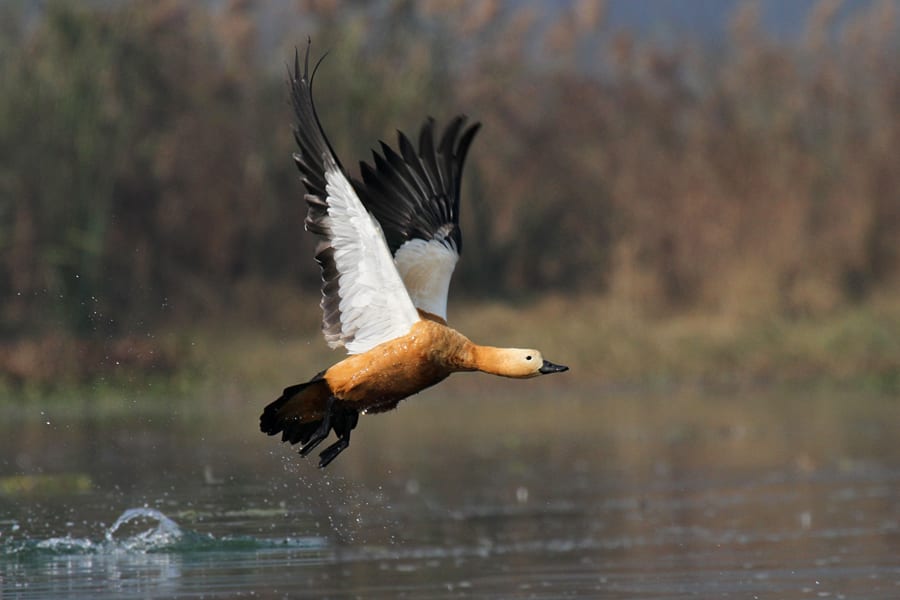
The male has orange-brown body plumage and a paler, orange-brown head and neck, separated from the body by a narrow black collar. The rump, flight feathers, tail-coverts and tail feathers are black and there are iridescent green speculum feathers on the inner surfaces of the wings. Both upper and lower wing-coverts are white, this feature being particularly noticeable in flight but hardly visible when the bird is at rest. The bill is black and the legs are dark grey. The female is similar but has a rather pale, whitish head and neck and lacks the black collar, and in both sexes, the colouring is variable and fades as the feathers age. The birds moult at the end of the breeding season and the male loses the black collar, but a further partial moult between December and April restores it. Juveniles are similar to the female but are a darker shade of brown. The call is a series of loud, nasal honking notes, it being possible to discern the difference between those produced by the male and the female. The calls are made both on the ground and in the air, and the sounds are variable according to the circumstances in which they are uttered.
Taxonomy
- Kingdom
- Animalia
- Phylum
- Chordata
- Class
- Bird
- Family
- Anatidae
- Genus
- Tadorna
- Species
- ferruginea
Habitat
The main breeding area of the bird is from southeast Europe across central Asia to Lake Baikal, Mongolia, and western China. Outside the breeding season it prefers lowland streams, sluggish rivers, ponds, flooded grassland, marshes and brackish lagoons.
Diet
It is omnivorous and feeds on grasses, the young shoots of plants, grain and water plants as well as both aquatic and terrestrial invertebrates. On land it grazes on the foliage, in the water it dabbles in the shallows, and at greater depths, it up-ends, but it does not dive.
Behavior
The ruddy shelduck is a mainly nocturnal bird. A clutch of about eight eggs (range six to twelve) is laid between late April and early June. These have a dull gloss and are creamy-white, averaging 68 by 47 mm (2.68 by 1.85 in). Incubation is done by the female while the male stands in attendance nearby. The eggs hatch after about twenty-eight days and both parents care for the young, which fledge in a further fifty-five days. After breeding the adults moult, losing the power of flight for about a month while they do so. Before moulting they move to large water bodies where they can more easily avoid predation while they are flightless. The family may stay together as a group for some time; the autumn migration starts around September and the young may mature in their second year. North African birds breed about five weeks earlier, and their breeding success is greater in wet summers.
Hunting
Hunted across its range.
Conservation Status
Listed as Least Concern by IUCN.