
Overview
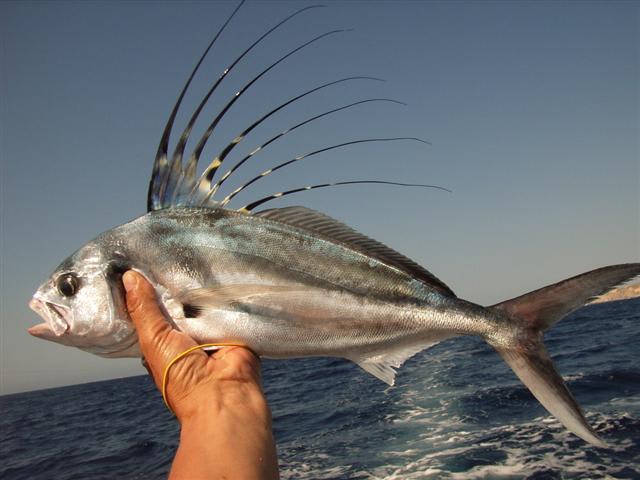
The distinctive dorsal fins of the roosterfish normally remain retracted in a deep groove along the fish's back, but when the fish is excited the fins rise. There are two dark blue or black, curved bands on the flanks. One begins from the front and the other from the back of the first dorsal fin. Both run diagonally down the flanks towards the front of the anal fin then curve smoothly and run along the flanks to the tail base. The dorsal spines are banded with alternate dark and light stripes and the lower base of the pectoral fins is black.
Taxonomy
- Kingdom
- Animalia
- Phylum
- Chordata
- Class
- Actinopterygii
- Order
- Perciformes
- Family
- Nematistiidae
- Genus
- Nematistius
- Species
- pectoralis
Habitat
An in shore species, it is found in the surf, over sandy bottoms, and in moderate depths. the maximum movement being about 300 miles (483 km).
Diet
Roosterfish primarily feed on small fish such as sardines, anchovies, and mackerel, as well as squid and crustaceans. They are ambush predators that hunt in shallow waters, often during dawn and dusk when prey is most active. Their feeding involves quick pursuits and strikes to capture fast-moving targets.
Behavior
It is a predator of small fishes.
Fishing
When hooked or in pursuit of prey it will raise its dorsal fin like a flag and leap repeatedly, greyhounding over the surface. Fishing methods are trolling or casting baits and lures, or live bait fishing from a boat or shore. The roosterfish has strong local commercial value. The flesh is tasty and of good quality.
Conservation Status
Listed as Not Evaluated by IUCN.