
Overview
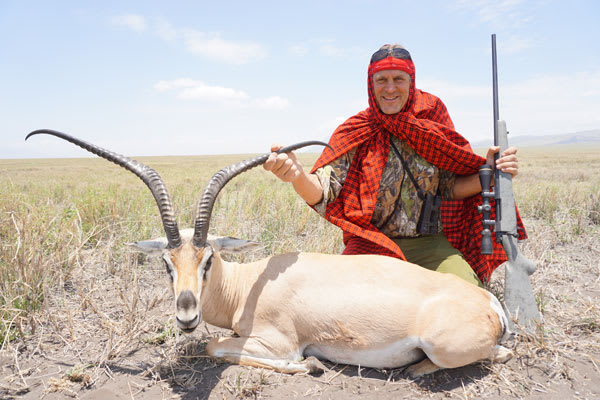
Similar to the southern Grant's gazelle, except that the male's horns are not lyrate, but bend sharply outward at a point about one-third of their length from the base, so that the tips are very far apart, and the tips then bend either downward or backward. Females have normal horns. Flank bands in females are either absent or very faint.
Taxonomy
- Kingdom
- Animalia
- Phylum
- Chordata
- Class
- Mammal
- Order
- Artiodactyla
- Family
- Bovidae
- Genus
- Nanger
- Species
- Nanger granti
Habitat
Plains and scrub grasslands. Distribution- In Tanzania, from Mwanza on Lake Victoria to the Serengeti Plains; and northward to the Loita Plains in Kenya.
Diet
Primarily a grazer but will browse when necessary.
Behavior
They are migratory animals, but travel in the opposite direction of most of the other ungulates, such as Thomson's gazelles, zebras, and wildebeest, which are more water dependent. They can subsist on vegetation in waterless, semiarid areas, where they face little competition.
Hunting
Hunting methods will vary based on topography of the specific area, but generally they are pursued through spot and stalk methods, glassing from vantage points and then pursuing a herd containing a desired male. Hunters should be prepared for potentially long shots. They can be found out in agricultural fields, plains, and mixed topography.
Conservation Status
Listed as Least Concern by IUCN, but this is referring to the species as a whole.