
Overview
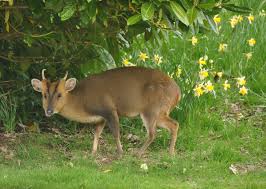
A very small deer. General color is reddish-brown, with the legs darker and a black stripe on the back of the neck. A broad black stripe runs up the middle of the face and branches up the horn pedicels, forming the letter Y. The underparts, throat, chin, and underside of the long tail are white. Antlers, which grow from bony, hair-covered pedicels, consist of a short, gently curved spike with a single, very short tine close to the base. Upper canine teeth of the male are elongated into tusks that protrude from the lips. The female has small, bony knobs and hair tufts in place of antlers, and does not have tusks.
Taxonomy
- Kingdom
- Animalia
- Phylum
- Chordata
- Class
- Mammal
- Order
- Artiodactyla
- Family
- Cervidae
- Genus
- Muntiacus
Habitat
Woodland with thick undergrowth. Distribution- Ranges from Guangdong and Guangxi up to Gansu and Shaanxi, covering the vast subtropical region of the Zhujiang (Pearl) and Yangtze River catchment basins, as well as the island of Taiwan. In the U.K., inhabits southern region, specifically south of Leicester and east of Bristol.
Diet
Browses on shrubs, also eats acorns, fruit and some grass.
Behavior
Solitary or in pairs. Territorial. There is no fixed mating season, and fawns (normally one) may be born at any time of year. Feeds at night but also during the day if undisturbed. Usually near water. Runs with a characteristic hunched posture. The male has a remarkably loud bark that may be repeated for an hour or more when alarmed or during the rut.
Hunting
Hunted by stalking. To the best of our knowledge England is the only place in the world where this species may be hunted by a non-resident.
Conservation Status
Listed as Least Concern by IUCN. This status is worthy of re-evaluation, however, as this is mostly based on the large introduced population in the U.K., and native populations in China and Taiwan face many threats.