
Overview
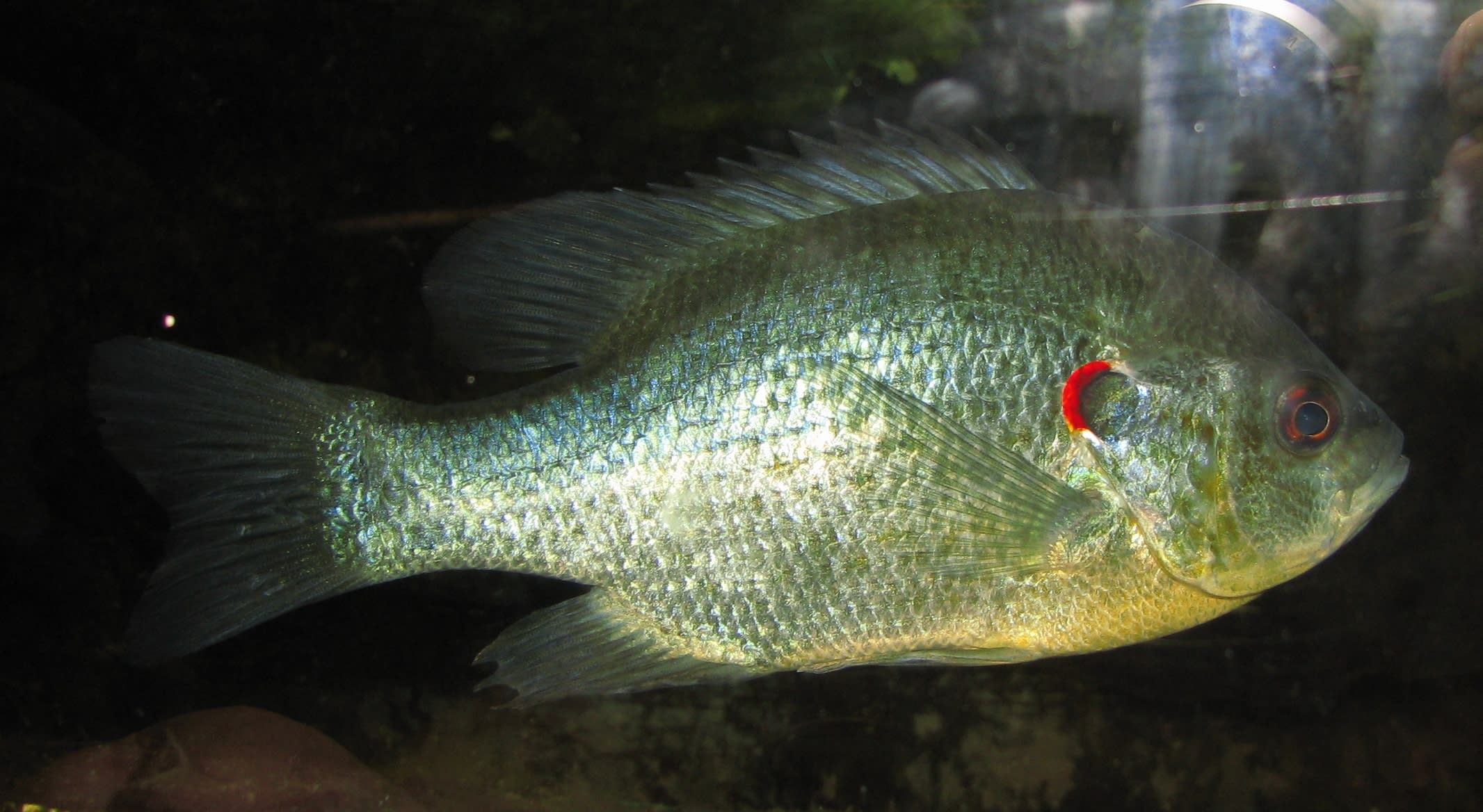
As is typical of sunfishes, the redear has a small mouth, connected dorsal fins and a roundish, laterally compressed body. Its long, pointed, slightly falcate pectoral fins distinguish it from both the longear sunfish and the redbreast sunfish, which have short, roundish pectoral fins. The opercular flap is also much shorter than in the other two species and is black, with a red spot or margin at the tip. Color ranges from dark olive green above to almost white on the belly. The sides are usually yellow to green. The spinous dorsal fin, which is anterior to the soft dorsal fin, is normally equipped with 10 spines, although 9 or 11 spines are sometimes observed, and it is broadly connected to the soft dorsal fin. The anal fin has three spines. The species' most distinct characteristic is the red edge on the opercle (ear) flap of the male (orange on the female). The opercle flap is never greatly elongated as it is in species such as the redbreast sunfish(Lepomis auritus) or the longear sunfish (L. megalotis).
Taxonomy
- Kingdom
- Animalia
- Phylum
- Chordata
- Class
- Actinopterygii
- Order
- Cypriniformes
- Family
- Centrarchidae
- Genus
- Lepomis
- Species
- microlophus
Habitat
The species is usually found near the bottom in warm water with little current and abundant aquatic vegetation.
Diet
Redear sunfish often utilize snails as a major food item, hence the common name shellcracker. However, insect larvae and cladocerans may also be found in their diet.
Behavior
Redears normally reach sexual maturity by the end of their second year. They spawn during the warm months of late spring and early summer, and in deeper water than most other sunfish, congregating in spawning beds. Nests are saucer-shaped depressions in gravel or silt, and are sometimes so close they almost touch. There are usually one or two peaks of activity during spawning season.
Fishing
Rarely, the redear will take a small fly or other small lure. It is strictly an angler's fish and has no commercial value. Like the bluegill and other sunfishes, it is an excellent panfish with white, flaky meat. It is less likely to be caught on artificials, such as spinners or poppers, than the other sunfishes.
Conservation Status
Listed as Least Concern by IUCN.