
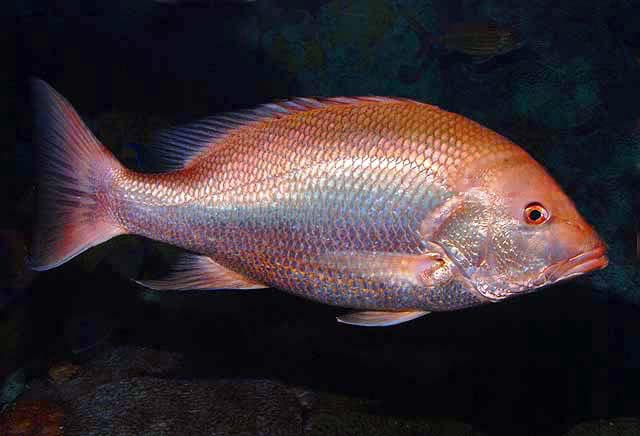
Overview
Overall rosy red. Canine teeth less prominent than those of most other Snappers. Red eye. Anal fin is triangular. The Caribbean Red Snapper, Lutjanus purpureus, is very similar in appearance and is found in the northwest and central Caribbean. The snout is long and triangular and the eyes are a distinctive red. Adults have no dark lateral spot, but juveniles have a dark spot on the upper sides below the anterior soft dorsal fin.
Taxonomy
- Kingdom
- Animalia
- Phylum
- Chordata
- Class
- Actinopterygii
- Order
- Perciformes
- Family
- Lutjanidae
- Genus
- Lutjanus
- Species
- campechanus
Habitat
Juveniles occur in shallow water over sandy or mud bottoms. Adults are more plentiful offshore in 60 to 440 ft of water associated with rough, rocky bottoms and wrecks.
Diet
This species feeds primarily on fish, crustaceans, worms and cephalopods.
Behavior
Red snappers are schooling fish that often form groups around reefs and wrecks, making them social in nature. They are primarily diurnal, actively feeding during the day and resting at night. Adults can exhibit territorial behavior when defending feeding areas, and they undertake seasonal migrations along the continental shelf.
Fishing
They tend to be nibblers and pickers and soft touch is needed when angling. Red Snanpper seem to prefer a still or slowly moving bait. Squid, whole fish and cut bait can be used to entice Red Snapper to bite. By chummming them up to the surface, flies can also be used. The Red Snapper is one of the most valuable and heavily exploited snappers in American waters. It is now closely protected; shrimp fishing, accused of destroying young snappers, is currently restricted.
Conservation Status
Listed as Vulnerable by IUCN.