
Overview
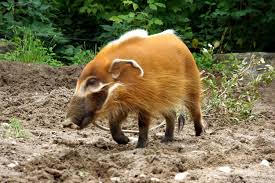
The red river hog is the smallest African pig, averaging slightly smaller than the bushpig, and is the most brightly colored of all the world's wild pigs. Coat is a bright brownish orange, with a narrow white dorsal crest, darker legs and bold black-and-white facial markings. Forehead and mask are black, there are white eye rings, white whiskers along the jaw, and the long, pointed ears have white margins and end in long, white tassels. Long, bristly hairs grow on most of the face and along the flanks, but the coat is short and dense on the forehead and the rest of the body, giving the animal a smooth, trim look that is very different from the shaggy, crested appearance of the bushpig. The long, thin tail ends in a black tuft. The head is elongated and ends in a flattened snout. Males have small, wart-like skin growths on the sides of the face. The canines form small short tusks (the lowers are larger) that wear against each other, honing sharp edges. Females have three pairs of teats. Juveniles are a dark reddish brown with pale yellow horizontal stripes.
Taxonomy
- Kingdom
- Animalia
- Phylum
- Chordata
- Class
- Mammal
- Order
- Artiodactyla
- Family
- Suidae
- Genus
- Potamochoerus
Habitat
Rain forest, secondary forest, and gallery forest where there is thick cover. Prefers moist areas with soft ground and permanent water. Distribution- The equatorial rainforest belt from Senegal in the west to the Central African Republic and Congo (K) in the east, and southward through Congo (K) as far as the Kasai River and the savanna zone of Shaba Province. Also occurs marginally in the forest zone of southwestern Sudan along its borders with the C.A.R. and Congo (K).
Diet
Omnivorous, feeding mainly on roots, bulbs, fruits and berries, occasionally on frogs, snakes, birds and eggs. Forages by digging (rooting) with the muzzle, tusks and front feet. Fond of crops, can cause great damage to farmland. Wanders over a large area in search of food.
Behavior
A social animal, living in groups of 4-10, sometimes up to 20. Mainly nocturnal, resting during the day. A good swimmer. Three to six young are born after five months gestation.
Hunting
Common methods include tracking, stalking, and still hunting. This animal travels well defined paths twice a day when going to, or returning from its burrow. Set up a blind near the trail and spend the early morning hours watching for the hog. Where legal, hunting red river hogs in Africa is done by using a spotlight at night when they are active. This can be a highly effective way of hunting red river hogs in Africa, and is the most effective way of removing them from crop fields.
Conservation Status
Listed as Least Concern by IUCN.