
Overview
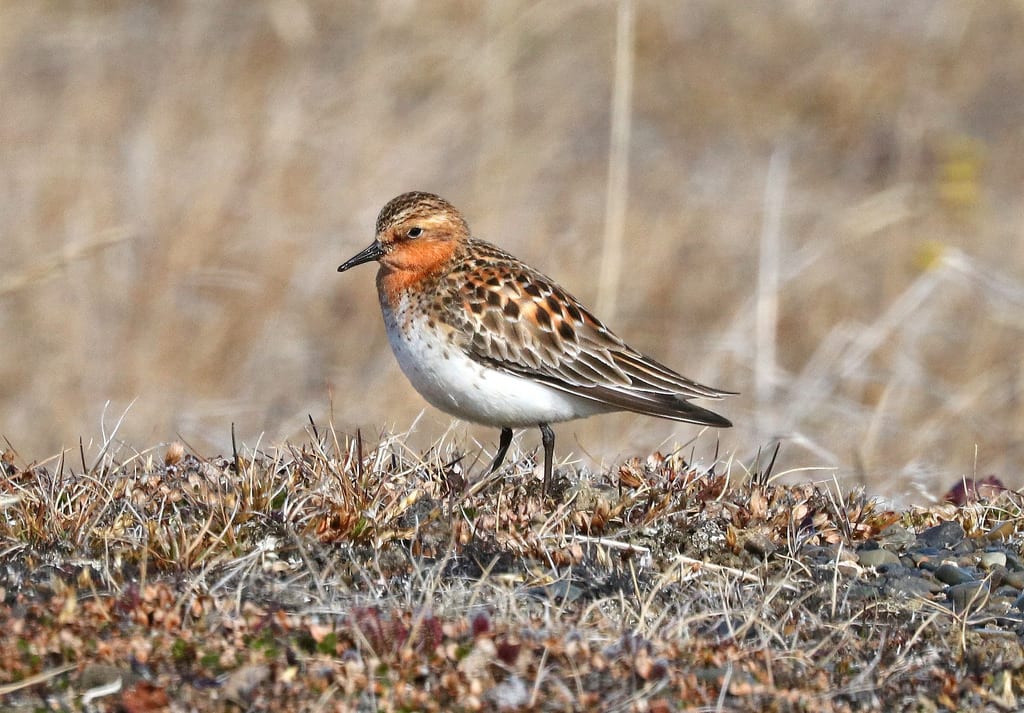
These birds are among the smallest of waders, very similar to the little stint, Calidris minuta, with which they were once considered conspecific. The red-necked stint's small size, fine dark bill, dark legs and quicker movements distinguish this species from all waders except the other dark-legged stints. It can be distinguished from the western sandpiper and the semipalmated sandpiper in all plumages by its combination of a fine bill tip, unwebbed toes, and longer primary projection. The breeding adult has an unstreaked orange breast, bordered with dark markings below, and a white V on its back. In winter plumage identification is difficult, although it is shorter legged and longer winged than the little stint. Juveniles have more contrasting mantle plumage and weaker white lines down the back than their relative. The call is a hoarse stit.
Taxonomy
- Kingdom
- Animalia
- Phylum
- Chordata
- Class
- Bird
- Family
- Charadriidae
- Genus
- Calidris
- Species
- ruficollis
Habitat
Tundra while breeding, farther south in coastal areas while wintering.
Diet
They mainly eat insects and other small invertebrates.
Behavior
Red-necked stints are highly gregarious and will form flocks with other small Calidris waders, such as sharp-tailed sandpipers and curlew sandpipers in their non-breeding areas. Their breeding habitat is tundra. They nest on the ground and breed from spring to summer. They forage in wet grassland and soft mud, mainly picking up food by sight. In their non-breeding habitat they feed on intertidal mudflats and along the muddy margins of freshwater lakes.
Hunting
More information is needed.
Conservation Status
Listed as Near Threatened by IUCN.