
Overview
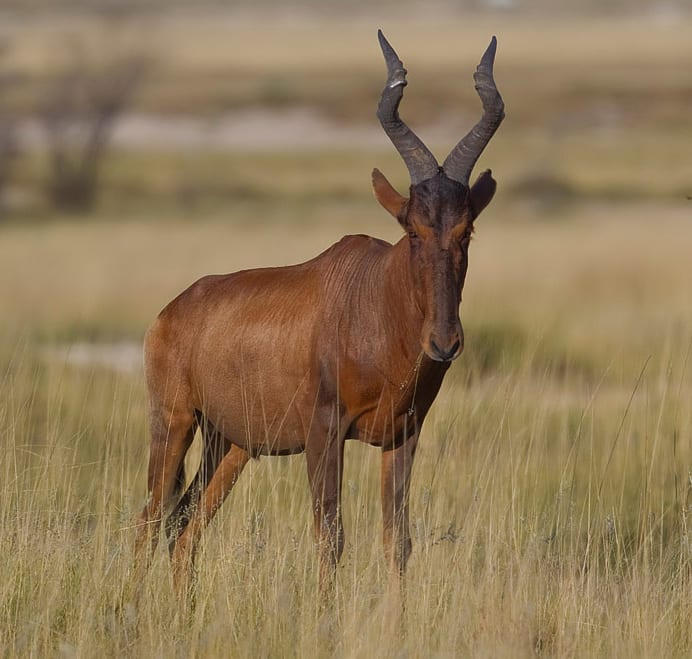
The Red hartebeest is a larger hartebeest with a long face and a high frontal pedicel. The general color is some shade of bright reddish brown. The forehead is black and there is a dark facial blaze that is interrupted by a lighter band between the eyes. There are blackish markings on back of neck, chin, shoulders, hips and legs, and a wide, yellowish-white patch on sides and lower part of the rump. The horns (both sexes) are thick and V-shaped when viewed from the front. They grow slightly out and back from the pedicel, then up and forward, and finally bend sharply backward.
Taxonomy
- Kingdom
- Animalia
- Phylum
- Chordata
- Class
- Mammal
- Order
- Artiodactyla
- Family
- Bovidae
- Genus
- Alcelaphus
- Species
- Alcelaphus buselaphus
Habitat
Open plains and scrublands. Distribution- Much of Namibia, extending into southern Angola between the Cunene and Cubango rivers, and throughout the Kalahari region of Botswana. Vagrants occasionally wander into western Zimbabwe. In South Africa it formerly occurred in the western Transvaal, in parts of the Orange Free State and Natal, and throughout Cape Province; however, it was exterminated by early European settlers except for a narrow strip in the Northern Cape near Botswana. Now widely reintroduced on government reserves and private ranches, especially in the drier regions. Once again a common species, with its numbers increasing.
Diet
Primarily a grazer.
Behavior
Hartebeests have an excellent sense of hearing and smell, although their sense of sight is poor. When alarmed, hartebeests elude confusion before running, by which they can reach a maximum speed of 55 km/h. Their evasion tactic is to run in a zigzag pattern, making it difficult for predators to catch them.
Hunting
The Red hartebeest is by far the most heavily hunted of the hartebeests, with most animals being taken from private ranches in Namibia and South Africa. Such ranch hunting is not necessarily easier or less sporting than hunting free-ranging animals from Botswana-in fact the opposite is likely to be true. Most ranch hartebeests are hunted regularly and are more likely to be wary and wild than those from the vast Kalahari, many of whom scarcely ever see a hunter.
Conservation Status
Listed as Least Concern by IUCN, with an estimated total population of 130,000 that is considered to be expanding.