
Overview
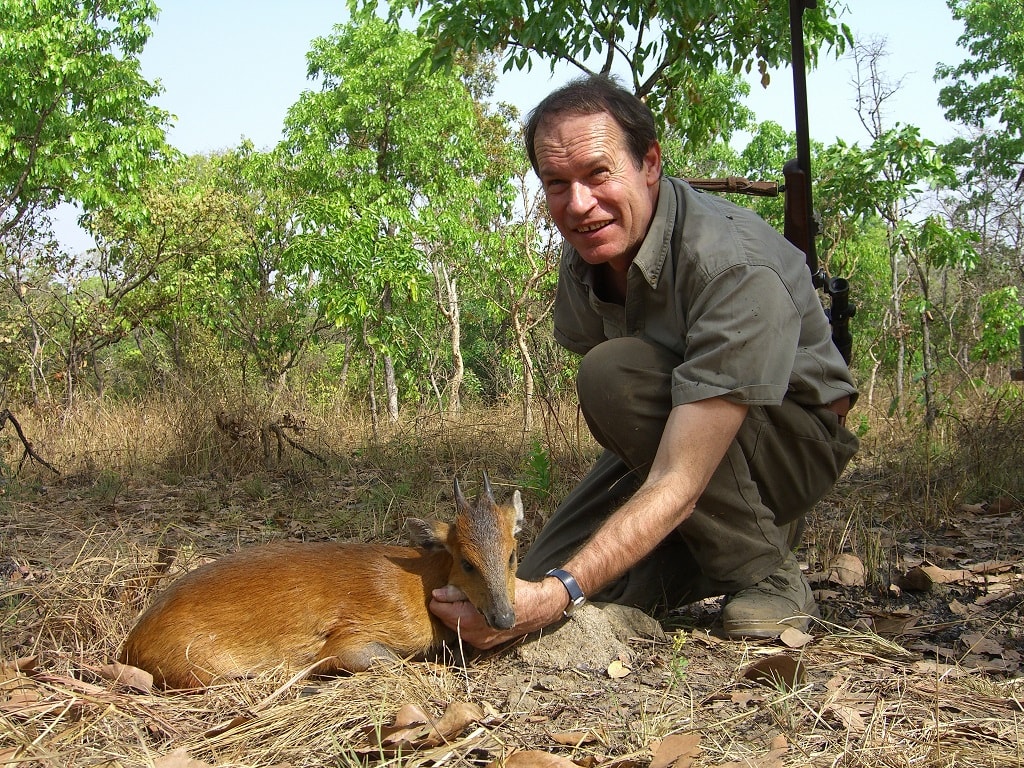
A rather slender, elegant duiker. The general color is bright orange red, with a broad bluish-gray stripe from nose to tail (lighter in the western race, darker in the eastern), widening on the back, and bluish gray lower legs. The head tuft is black. The ears are wide, and blackish on the back. The tail has a black tip. Chin, throat and belly are whitish or light orange. Skull is narrow, with the largest and deepest preorbital gland pits for its head size of any red-colored duiker. Inguinal (groin) glands are present. The horns (in males only) are cone-shaped, ringed at the base, straight, and grow backward in the plane of the face. Females are similar to males, but slightly larger and without actual horns, although they may have small tubercles.
Taxonomy
- Kingdom
- Animalia
- Phylum
- Chordata
- Class
- Mammal
- Order
- Artiodactyla
- Family
- Bovidae
- Genus
- Cephalophus
Habitat
Forest edges, gallery forest, and savanna thickets. Not in primary rain forest. Distribution- Widely but locally distributed in West and Central Africa, specifically: southern Senegal, Gambia, Guinea-Bissau, Guinea, northern Sierra Leone, southern Mali, southern Burkina, northern Ivory Coast, northern and eastern Ghana, Togo, northern Benin, extreme southwestern Niger, southern and central Nigeria, central Cameroon, far southern Chad, most of the Central African Republic, southwestern Sudan, and extreme northeastern Congo (K). May still exist west of the Albert Nile in northwestern Uganda.
Diet
This animal both grazes and browses.
Behavior
Inhabit more open country than other forest duikers, thus are more frequently seen. They live on the edge of the forest, hiding in dense cover, but emerging into openings to feed. They live singly or in pairs, and are most active during early morning and late afternoon. They run in a bouncing manner with the head down. Alarm call is a shrill bark.
Hunting
Hunting the red-flanked duiker, a nimble antelope found in West and Central Africa, relies on spot-and-stalk methods in savanna thickets and forest edges, where they are most active during early morning and late afternoon; use binoculars for spotting and move quietly to get within range. Opt for a light caliber like .243 Winchester or 6.5 Creedmoor with a scoped rifle for precise shots, targeting the vitals just behind the shoulder for a quick, ethical harvest. The best hunting seasons run from November to April during the dry months, when drier conditions improve visibility and animal movement in countries such as Cameroon, Central African Republic, and Nigeria, typically through licensed outfitters on private conservancies. For trophy criteria, focus on mature males with straight, ringed horns measuring at least 4 inches for record book consideration in Safari Club International (SCI), emphasizing symmetry and overall form. Regulated hunting of this Least Concern species, as classified by IUCN, supports conservation through hunting fees that fund anti-poaching patrols and habitat management, demonstrating how such programs sustain healthy populations across their range.
Conservation Status
Listed as Least Concern by IUCN, but more research is necessary to properly determine the status of this animal.