
Overview
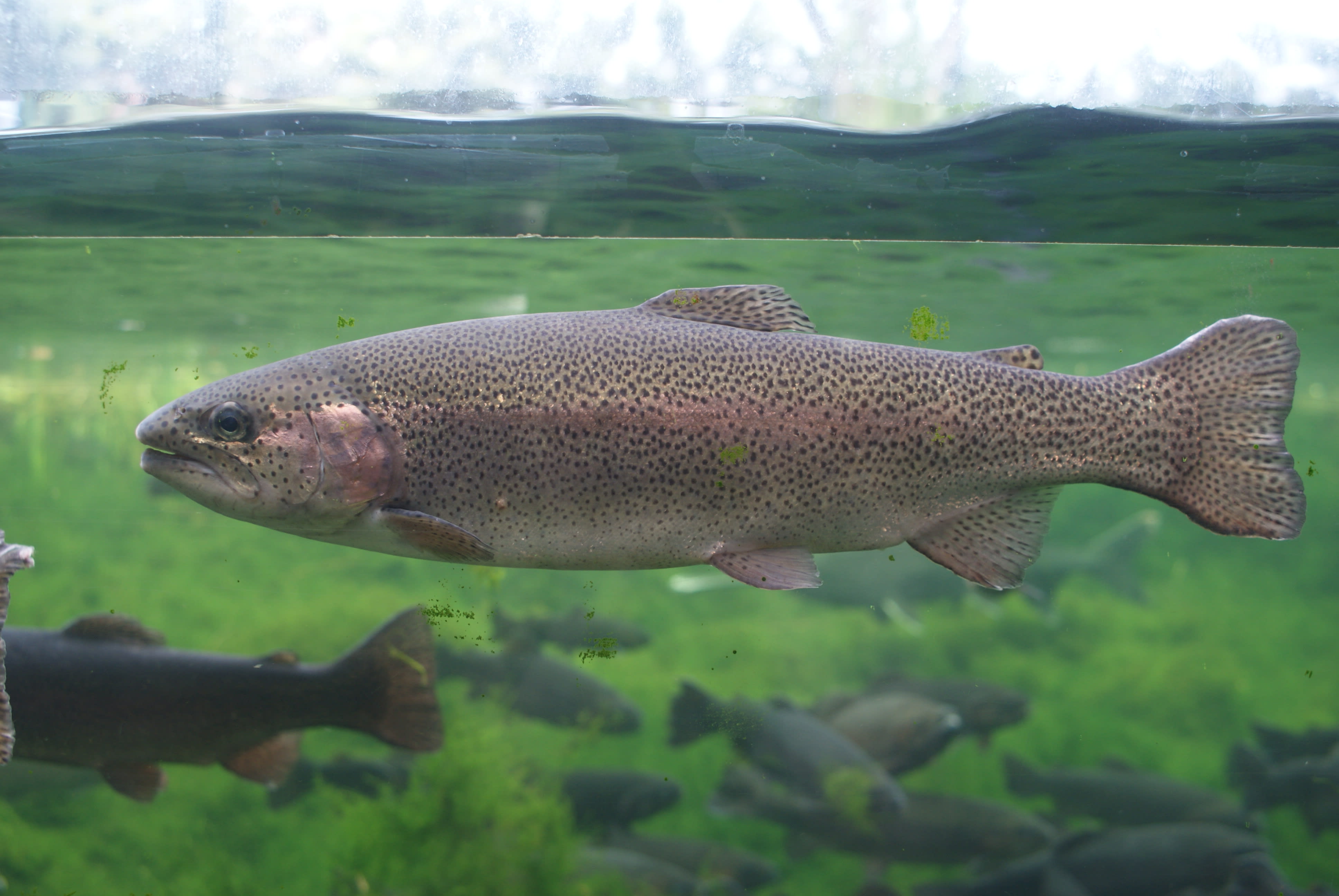
Rainbow trout have a characteristic salmon-like shape. Dark spots are clearly visible on the tail fin, which is slightly forked. The anal fin has 10-12 rays. The back is usually a dark olive color, shading to silvery white on the underside. The body is heavily speckled, and there is a pink to red stripe running lengthwise along the fish's sides.
Taxonomy
- Kingdom
- Animalia
- Phylum
- Chordata
- Class
- Actinopterygii
- Order
- Perciformes
- Family
- Salmonidae
- Genus
- Oncorhynchus
- Species
- mykiss
Habitat
Since rainbow trout generally do not reproduce in Texas, and are unable to survive through the summer in most areas, the species is primarily used in winter put-and-take fisheries. Each winter, several hundred thousand rainbows are stocked in community fishing lakes around the state. Much enthusiasm is generated by the annual stockings.
Diet
Rainbow trout are carnivores, but not exclusively piscivorous. They feed on a wide variety of prey including insects, crustaceans, mollusks and fish.
Behavior
Rainbow trout is an anadromous, cool- to cold-water fish species. Although rainbows have been known to tolerate higher temperatures, they do best in areas where the water remains below 70°F. Eggs are laid in shallow nests dug out by the female in gravel riffles. The eggs require continuous oxygenation. At temperatures of about 55°F, the eggs will hatch approximately 21 days after they are laid.
Fishing
Rainbow trout and steelhead are highly regarded game fish. Rainbow trout are a popular target for fly fishers, and several angling methods are used. The use of lures presented via spinning, casting or trolling techniques is common. On occasion, banks are lined with anglers eager to catch their limit immediately after trout are stocked.
Conservation Status
Listed as Not Evaluated by IUCN.