
Overview
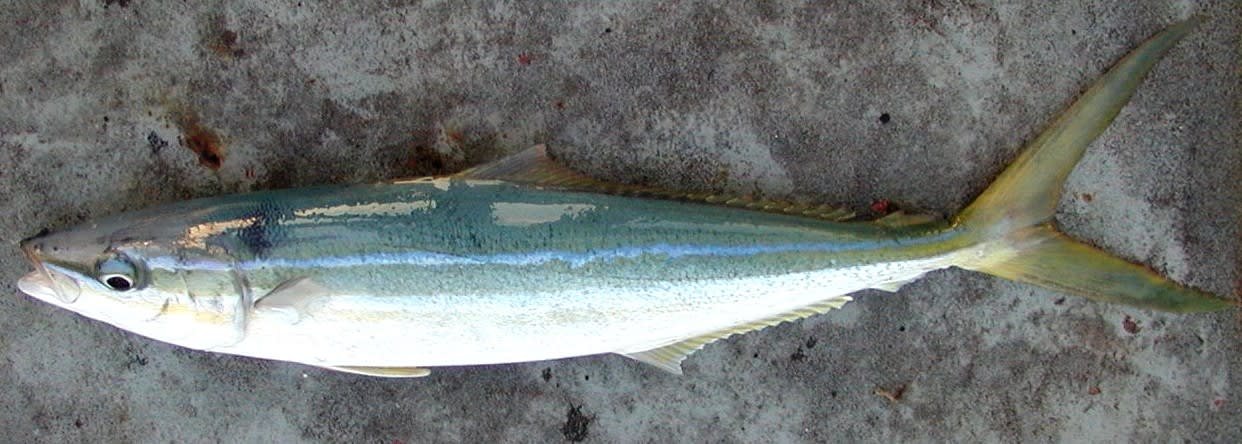
There is a groove on the back and another on the venter in front of the tail fin of this species, but there are no bony scutes on the sides. The first dorsal fin has six spines. The second dorsal fin has one spine and 25 27 connected soft rays, followed by a 2 rayed finlet. The anal fin consists of a single detached spine that is covered by skin in most specimens over 1 ft (30 cm) long, followed by another spine with 16 18 connect soft rays and a 2 rayed finlet. It resembles the Cobia (Rachycentron canadum) in shape, but can be distinguished by its coloration as well as the finlet after the dorsal and anal fins. The back is blue green. On each side there is a broad, dark blue, horizontal stripe near the back and one or two narrower, light blue stripe(s) beneath the broader one. Between and around these blue stripes, the sides are a cadmium yellow. The belly is white or silver, often with a yellow or pink tint. The tail is yellow and the other fins are a greenish or olive yellow.
Taxonomy
- Kingdom
- Animalia
- Phylum
- Chordata
- Class
- Actinopterygii
- Order
- Cichliformes
- Family
- Carangidae
- Genus
- Elagatis
- Species
- bipinnulata
Habitat
Occurs worldwide in tropical and warm temperate waters. Young are known to occur in the vicinity of floating rafts or debris and have been seen swimming with large sharks accompanied by pilotfish. It is rarely found in shore being more an inhabitant of the open sea.
Diet
Rainbow runners primarily feed on smaller fish such as sardines, mackerel, and anchovies, as well as squids and crustaceans like shrimp and crabs. They are active predators that hunt in open waters, often chasing prey in schools during the day. Feeding typically occurs near the surface or mid-water columns.
Behavior
Young fish probably swim in relatively loose, small schools; older fish are more solitary.
Fishing
Fishing methods include trolling with small baits and lures or live bait fishing. The rainbow runner is sometimes caught on heavy tackle intended for larger fish, but its fighting ability is reduced when this happens. When hooked on light tackle, it is an excellent game fish and a tough fighter prone to fast surface runs. happens. When hooked on light tackle, it is an excellent game fish and a tough fighter prone to fast surface runs.
Conservation Status
Listed as Least Concern by IUCN.