
Overview
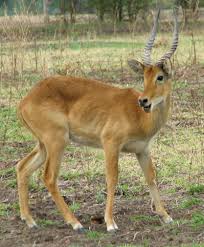
The puku is a medium-sized antelope closely related to the kob. The back is straight, the tail short, the coat fairly long. Color is a bright golden yellow. Underparts are whitish, and there are whitish areas around the eyes, on the sides of the muzzle, and on the throat. No black markings on the legs. Horns (males only) are thick, short, lyrate and heavily ringed. The female is similar but somewhat smaller, has a brownish crown and no horns.
Taxonomy
- Kingdom
- Animalia
- Phylum
- Chordata
- Class
- Mammal
- Order
- Artiodactyla
- Family
- Bovidae
- Genus
- Kobus
Habitat
Open flats near rivers or swamps, never far from water. Distribution- Discontinuously in northeastern Angola, Zambia, the Chobe region in Botswana, Katanga Province in Congo (K), southwestern Tanzania, and Malawi.
Diet
Mainly a grazer, but browses occasionally. Drinks water regularly.
Behavior
Usually lives in small herds of up to 10, sometimes more, but after the breeding season females and young form larger herds of up to 50. Males are in small bachelor groups or are solitary. When breeding, males defend small territories in a common territorial ground or lek, similar to a kob.
Hunting
Walking and stalking in the likely habitat for puku which is never far from water. They are best found at dawn or dusk grazing on flood plains or in open woodland near water. Look for good horn length and thick bases. If the first bend in the horns starts above the level of the ear tip, it is likely to be a good trophy puku.
Conservation Status
Listed as Near Threatened by IUCN. The largest population, in the Kilombero Valley, is suspected to have declined at around 37% over the past 19 years (three generations). Populations in Zambia are reportedly stable so the overall decline in the global population over three generations is suspected to be closer to 25%. (IUCN)