
Overview
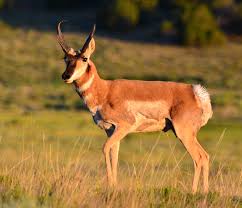
Pronghorn antelope, fastest land animal in North America and popular hunting species.
Taxonomy
- Kingdom
- Animalia
- Phylum
- Chordata
- Class
- Mammal
- Order
- Artiodactyla
- Family
- Antilocapridae
- Genus
- Antilocapra
Habitat
Pronghorns primarily inhabit open grasslands, shrublands, and deserts in western North America, from southern Canada to northern Mexico. They prefer flat or rolling terrain with sparse vegetation for easy visibility and escape. These areas often include sagebrush steppe and prairies, avoiding dense forests.
Diet
Pronghorns are herbivores that primarily eat grasses, forbs, and shrubs, with a preference for nutrient-rich plants like sagebrush and alfalfa. They feed mostly in the early morning and late afternoon to avoid the heat of the day, browsing on a variety of vegetation depending on seasonal availability.
Behavior
Pronghorns are highly social, forming herds of up to several dozen individuals, particularly during migration and winter. They are diurnal, most active at dawn and dusk, and exhibit strong territorial behavior in males during the breeding season. Known for their incredible speed and endurance, they can run long distances to evade predators and often use keen eyesight to detect threats from afar.
Hunting
Pronghorn hunting is a classic North American pursuit that showcases the species' speed and agility across open grasslands and sagebrush plains, primarily using spot-and-stalk methods or blinds for close-range opportunities; long-range rifles are essential due to their keen eyesight and evasion tactics, with recommended calibers like .243 Winchester, .270, or .30-06 for ethical, one-shot kills targeting the heart-lung area behind the shoulder. The prime season runs from September to October during the rut, when males are more territorial and easier to locate, enhancing success rates in flat or rolling terrain where wind direction and binoculars play key roles in strategy. Trophy pronghorns are evaluated by Boone & Crockett standards, focusing on horn length and prongs, with top specimens exceeding 14 inches for record-book status. Legal hunting is available in western U.S. states such as Wyoming, Montana, Colorado, and New Mexico, as well as parts of southern Canada and northern Mexico, all managed through state-regulated tag systems that ensure population health and habitat protection; these programs, funded by hunter fees via the Pittman-Robertson Act, have directly contributed to pronghorn recovery and conservation, maintaining stable populations through data-driven wildlife management.
Conservation Status
The IUCN classifies the pronghorn as Least Concern, with populations stable or increasing due to conservation efforts. Major threats include habitat loss from agriculture and energy development, as well as vehicle collisions.