
Overview
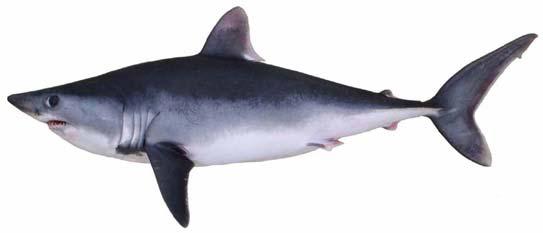
It is in the same family as the white and the mako sharks and they resemble each other. The snout is perfectly conical and ends in a point, and there is a large, very prominent flattened keel on either side of the caudal peduncle. It is easily distinguished from other sharks by its teeth, which are smooth and have little cusps on each side of the base. It has a small secondary keel than the white. The smaller keel is located beneath the main keel but farther back on the tail. The first dorsal fin is farther forward than on the mako or white sharks. Its anal fin is directly beneath the second dorsal fin, whereas the mako's anal fin originates near the midpoint of the second dorsal fin.having up to four pups measuring 19 ½ in (50 cm) long at birth. It has a distinguishing white patch on the free trailing base portion of the first dorsal fin. It follows migrations of mackerels, herring, cod, bonitos, etc., which is why it is often called mackerel shark, bonito shark, herring shark, etc.
Taxonomy
- Kingdom
- Animalia
- Phylum
- Chordata
- Class
- Chondrichthyes
- Order
- Myliobatiformes
- Family
- Lamnidae
- Genus
- Lamna
- Species
- nasus
Habitat
It inhabits cool temperate waters of the North Atlantic from South Carolina to Newfoundland, and from North Africa to Norway and Iceland. It also inhabits the Mediterranean Sea and the cool temperate waters of the southern Pacific. A pelagic, oceanic shark, it has nevertheless been found near shore on occasions.
Diet
The Porbeagle is warm blooded and ovoviviparous.
Behavior
They inhabit colder waters, which may account for the fact that there are no recorded instances of it ever attacking humans.
Fishing
The porbeagle is reported to be an excellent sport fish and may leap when hooked. The flesh is of good quality and texture and is said to taste somewhat like swordfish. Fishing methods include trolling or bait fishing while chumming. Baits include mackerel, herring, bonito, squid and other fishes.
Conservation Status
Listed as Vulnerable by IUCN.