
Overview
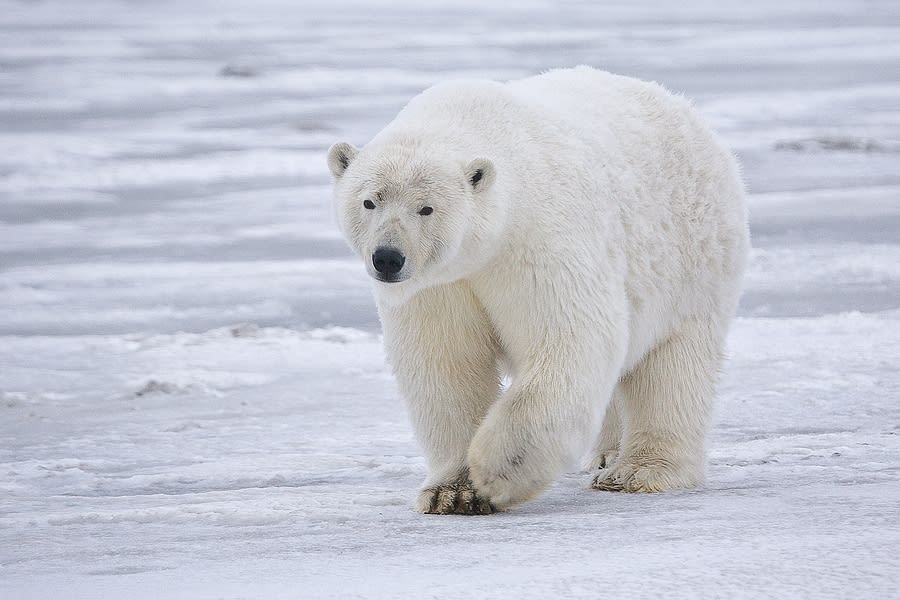
Polar bears are closely related to brown bears; fertile offspring have resulted from polar/brown bear crosses in zoos. Whether the polar bear or the Alaska brown bear is the world's largest land-based carnivore is a matter of conjecture, because few wild specimens of either have been weighed. The polar bear has a streamlined body that has adapted to an aquatic way of life. It has a longer neck than other bears, a relatively small head, long and massive legs, and large feet with hairy soles. The coat is a yellowish-white, which acts to conserve body heat and serves as camouflage in its snowy habitat. Eyes, nose, lips and toenails are black.
Taxonomy
- Kingdom
- Animalia
- Phylum
- Chordata
- Class
- Mammal
- Family
- Ursidae
- Genus
- Ursus
Habitat
The shores, islands and pack ice of the Arctic Ocean. Mature males often spend years out on the ice, while the pregnant females come ashore to den. Distribution- Circumpolar in the Northern Hemisphere, occurring in Eurasia as well as North America. Has been recorded as far north as latitude 88°N and as far south as the Pribilof Islands, Newfoundland, the southern tip of Greenland, and Iceland. There are permanent populations in James Bay and the southern part of Hudson Bay. Still occupies most of its historic range.
Diet
The most carnivorous of all bears, it feeds primarily on ringed seals, with bearded seals the second choice, followed by harp seals and hooded seals. Scavenges carcasses of walrus, whales and narwhals. Will kill other polar bears and, at times, young walrus, and land mammals such as caribou, musk ox, and small animals. Eats crustaceans, fish, birds, eggs and vegetation when other food is unavailable.
Behavior
Solitary except when mating or sharing a large carcass such as a stranded whale. Mating season is from March till June, with implantation apparently delayed several months so that the cubs are born November to January while the mother is in her winter den. The female gives birth every 2-4 years, with a litter numbering 1-4, but averaging two. Cubs remain with the mother 2 to 2-1/2 years. Females are fully grown at five years, males at 10-11 years. Longevity in the wild is estimated at 25-30 years. A captive polar bear lived almost 35 years. A great traveler, it roams the pack ice and surrounding seas in search of seals. Polar bears have been observed swimming as much as 40 miles (65 km) from the nearest ice or land. Sometimes swims with all four feet, but more often uses only the forefeet, with the hind feet trailing behind. Swims high in the water, with its head and shoulders exposed, and can attain a speed of four mph (6.5 km/h). Pregnant females den for the winter like other bear species (on shore, often in a hole on a steep mountain slope), but males and non-pregnant females remain active all winter. Sense of smell is excellent and eyesight is adequate. Hearing is good, but polar bears are not alarmed by most sounds because of their noisy environment in the continually grinding icepack.
Hunting
Since passage of the U.S. Marine Mammal Protection Act in 1972, polar bear hunting in Alaska has been closed to all except native Eskimos, or Inuits, who are allowed unlimited subsistence hunting. In 1973, the five arctic nations (United States, Canada, Denmark, Norway and the former U.S.S.R.) signed the Agreement for the Conservation of Polar Bears. Canada limits hunting to native Inuits, with a quota for each settlement, and allows settlements to sell permits from their quotas to visiting sportsmen and guide them on polar bear hunts. Denmark (for Greenland) limits polar bear hunting to resident Inuits. Norway (for Svalbard) and Russia protect them completely, although it is rumored that Russia may open limited hunting. The sportsmen's take of polar bears in Alaska during 1971-the next-to-last year hunting was allowed-was about 260, and was much fewer than that in prior years. The yearly worldwide kill by native people is estimated to be about 1,000 (Nowak, 1991). Yet, the polar bear is listed as vulnerable by the IUCN and on Appendix II of CITES (1975). The polar bear has never been listed by the USFWS, which, nonetheless, forbade importation of trophies taken legally in Canada until forced to do so by an Act of Congress, and even then delayed issuance of import permits for more than three years, and now closed.
Conservation Status
These bears are listed as Vulnerable by IUCN. Their analysis is as follows: In light of the significant probability, across scenarios, of a reduction in mean global population size greater than 30%, and the relatively low probability of a reduction greater than 50%, we conclude that Polar Bears currently warrant listing as Vulnerable under criterion A3c (IUCN 2014).