
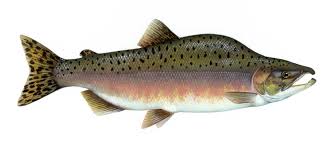
Taxonomy
- Kingdom
- Animalia
- Phylum
- Chordata
- Class
- Actinopterygii
- Order
- Perciformes
- Family
- Salmonidae
- Genus
- Oncorhynchus
- Species
- gorbuscha
Habitat
Pink salmon are anadromous, spending most of their lives in the cold, northern Pacific Ocean waters before returning to freshwater rivers and streams to spawn. They prefer coastal and estuarine environments in the ocean, and gravel-bottomed rivers in northern regions of North America and Asia for reproduction. These habitats include areas like the Mackenzie River and Bering Sea as noted.
Diet
Juvenile pink salmon primarily feed on plankton, small invertebrates, and insects in freshwater. In the ocean, adults consume small fish, squid, and krill, often feeding opportunistically during their migration. They are active feeders, particularly in pelagic waters where food is abundant.
Behavior
Pink salmon form large schools in the ocean for protection and feeding, but become solitary or form smaller groups during their upstream migration for spawning. They exhibit strong homing behavior, returning to their natal streams after 1-2 years at sea, and are most active during dawn and dusk in marine environments. After spawning, they die, which is a notable aspect of their life cycle.
Fishing
Pink salmon offer exciting angling opportunities as a key sport fish that supports conservation through license fees and habitat programs, making every catch a step toward protecting aquatic ecosystems. Target them using trolling with spoons, spinners, or flies during their late summer to early fall spawning runs, focusing on rivers and estuaries where they concentrate for reproduction; effective techniques include casting from shore or boats in areas like the Mackenzie River, Sacramento River, or Bering Sea. Use light to medium spinning or fly rods with 8-12 pound test line, paired with lures such as Vibrax spoons, Pixies, or bright attractor flies that mimic their ocean diet of small fish and krill, or natural baits like herring strips for added success. The best times are at dawn and dusk when pink salmon are most active in these cold, northern waters, allowing for higher catch rates while minimizing disturbance. Regulations, such as bag limits and catch-and-release requirements in certain regions, are proven management tools that maintain healthy populations and prevent overharvest, with angler-funded initiatives supporting stocking programs and waterway restoration. The IGFA all-tackle world record is 15 pounds 3 ounces, caught in 1986 in Alaska, underscoring the thrill of landing these fast-growing fish that typically reach 18 to 30 inches.
Conservation Status
Listed as Not Evaluated by IUCN.