
Overview
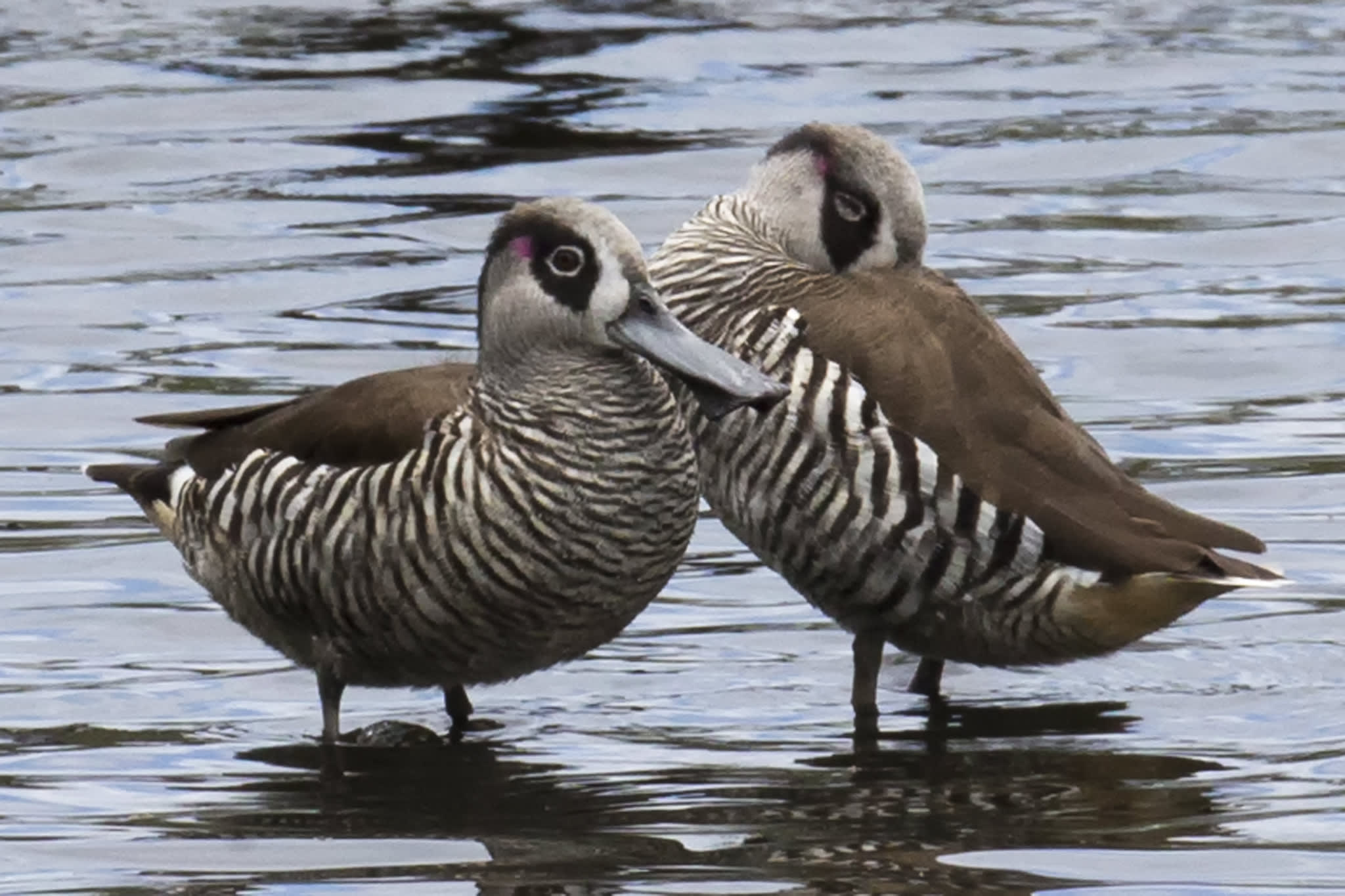
It has a large spatulate bill like the Australasian shoveler, but is smaller. Its brown back and crown, black and white barred sides and black eye patches on its otherwise white face make this bird unmistakable. Juveniles are slightly duller, but otherwise all plumages are similar. Its vernacular name refers to a pink spot in the corner formed by the black head pattern.
Taxonomy
- Kingdom
- Animalia
- Phylum
- Chordata
- Class
- Bird
- Family
- Anatidae
- Genus
- Malacorhynchus
- Species
- membranaceus
Habitat
Anywhere there is standing water, especially in dry inland regions, where annual rainfall rarely exceeds 15 in (380 mm).
Diet
Plankton, as well as crustaceans, mollusks and insects. Their bill is well designed for straining minute organisms, with pliable mandibular flaps that channel water in a manner that allow the ducks to filter algae and other plankton efficiently. They also feed by vortexing, in which two ducks spin about a central point with the head of one opposite the tail of the other, concentrating food in a gyrating water column.
Behavior
Nesting is stimulated by the drying and filling of pools that promote increased levels of organic material. In good years, large numbers of pink-eared ducks concentrate in shallow flood plains. However, when conditions do not meet specifications, reproduction may be completely curtailed.
Hunting
Hunted across its range.
Conservation Status
Listed as Least Concern by IUCN.