
Overview
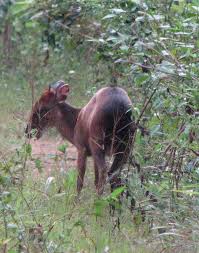
A medium-large duiker with a long, narrow muzzle. The hair on the nape of the neck is directed forward. The general color is yellowish brown in front, becoming reddish behind, with the underparts paler. A distinctive black dorsal band begins at the shoulders and extends to the rump, widening at the loins, and including the back surface of the hips and hind legs down to the hocks, as well as the top of the tail. The underside of the tip of the tail is white. The forehead and the head tuft (which is short) are orange brown, the side of the face is tan, and the lips, chin and throat are white. The legs are a little darker than the body. The horns (both sexes) are cone-shaped and thick and heavily ringed at the base. Females are similar to males, but are somewhat larger and have smaller horns.
Taxonomy
- Kingdom
- Animalia
- Phylum
- Chordata
- Class
- Mammal
- Order
- Artiodactyla
- Family
- Bovidae
- Genus
- Cephalophus
Habitat
High rain forest, and also in second-growth forest. Distribution- Southern Cameroon, extreme southwestern Central African Republic, Equatorial Guinea, Gabon and Congo (B). The Peters duiker is found west of the Congo and Ubangi rivers.
Diet
These animals browse on plants and fallen fruit.
Behavior
Solitary and nocturnal, concealing itself in a protected place during the day.
Hunting
Many hunts take place in Cameroon and it is best taken by shot-gun or a large caliber solid bullet. They can be found by spot and stalk methods or can be called in by using distress calls.
Conservation Status
Listed as Least Concern by IUCN.