
Taxonomy
- Kingdom
- Animalia
- Phylum
- Chordata
- Class
- Mammal
- Order
- Artiodactyla
- Family
- Bovidae
- Genus
- Ourebia
Habitat
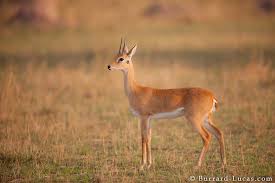
Oribi primarily inhabit grasslands, savannas, and open woodlands in sub-Saharan Africa, from Senegal to Ethiopia and south to South Africa. They prefer areas with short grass for grazing and nearby shrubs for cover, avoiding dense forests.
Diet
Oribi mainly eat grasses, herbs, and leaves, with a preference for young, tender shoots. They are grazers that feed primarily in the early morning and late afternoon, spending time selecting nutritious plants to meet their dietary needs.
Behavior
Oribi are typically solitary or form pairs, with males defending territories marked by dung and secretions. They are crepuscular, active at dawn and dusk, and exhibit a stiff-legged bounding escape when threatened. These antelopes are alert and rely on speed and agility to evade predators.
Hunting
The oribi is a sought-after small antelope for regulated hunting in sub-Saharan Africa, primarily through spot-and-stalk methods in open grasslands and savannas, where hunters use binoculars to spot and approach carefully for clean shots. Opt for light calibers like .243 Winchester or 6.5 Creedmoor with high-quality scopes for ethical precision, targeting the heart-lung area to ensure quick, humane harvests. The best hunting season runs from June to October during the dry months, when oribi are more visible and active in their preferred habitats. For trophies, focus on mature males with straight horns measuring 10-15 cm or more, which can qualify for records in Safari Club International (SCI) or Rowland Ward. Legal hunting is available in countries such as South Africa, Namibia, and Tanzania, often on private game ranches and conservancies, where hunting fees directly fund conservation programs, including anti-poaching initiatives and habitat protection, reinforcing the success of Southern African wildlife management systems in maintaining stable oribi populations.
Conservation Status
The IUCN status of oribi is Least Concern, but populations are decreasing due to habitat loss from agriculture and hunting pressure. Major threats include human encroachment and poaching in some regions.