
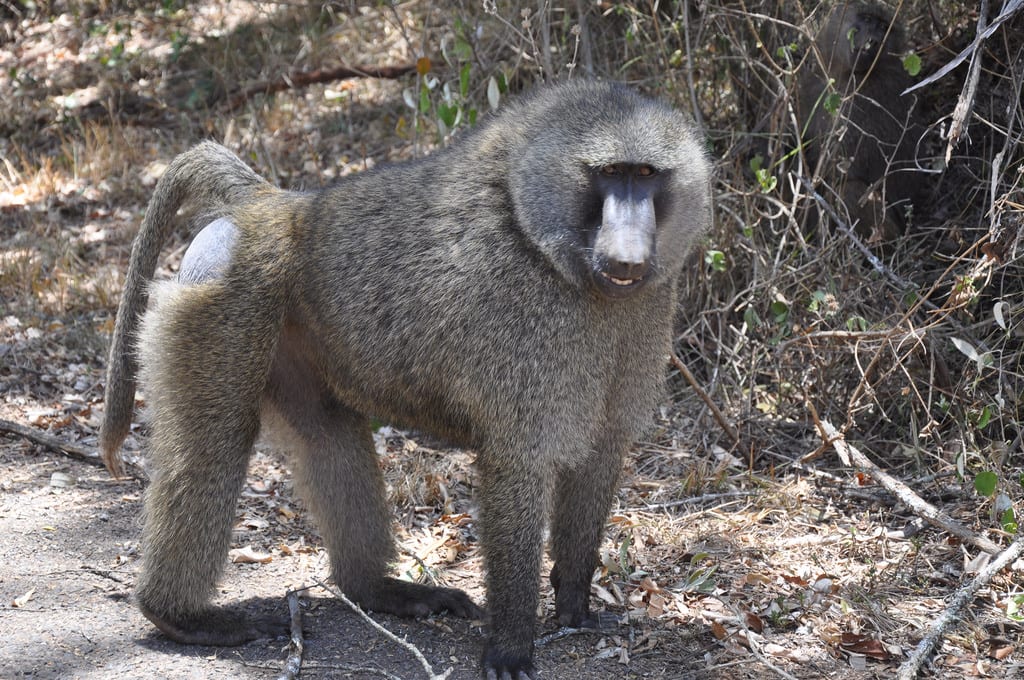
Overview
Baboons are some of the world’s largest monkeys. There are five species of baboon—olive, yellow, chacma, Guinea, and hamadryas—scattered across various habitats in Africa and Arabia. The baboon, like other Old World monkeys, does not have a prehensile (gripping) tail, but it is still able to climb when necessary. All baboons have dog–like noses, powerful jaws, sharp canine teeth, and thick fur. The male baboon also has a ruff—a longer mane around its neck.
Taxonomy
- Kingdom
- Animalia
- Phylum
- Chordata
- Class
- Mammal
- Family
- Cercopithecidae
Habitat
Savannas and woodlands
Diet
earthworms, insects, grubs, eggs and young of ground-nesting birds, small mammals, amphibians, reptiles, and birds, roots and fruit
Behavior
Baboons sleep, travel, feed, and socialize in groups of about 50. These groups usually consist of seven or eight males and about twice as many females plus their young. The family unit of females and juveniles forms the core of the troop. Male baboons will leave their natal troops as they mature and move in and out of other troops.
Hunting
The Olive Baboon is occasionally hunted in regulated contexts as a problem animal or for population management in certain African regions, where it helps fund conservation efforts by generating revenue for anti-poaching patrols and habitat protection programs. Effective hunting methods include spot-and-stalk approaches in savanna woodlands or driven hunts on private game ranches, focusing on areas with troop activity near water sources or agricultural edges; use a medium-caliber rifle like .308 Winchester or .30-06 Springfield for ethical, one-shot kills, paired with binoculars for observation and a suppressor to minimize disturbance. The best timing is during the dry season from June to October in sub-Saharan Africa, when visibility is high and baboons congregate around reliable water points, making it easier to assess targets. For trophy criteria, prioritize mature males with impressive canine teeth and a full mane, though they aren't typically entered into major record books like SCI; aim for animals over 50 pounds with clear physical dominance in the troop. Legal hunting is available in countries such as South Africa and Namibia under strict permits for crop protection or on private reserves, as well as on exotic game ranches in Texas, USA, where fees contribute to broader wildlife management systems that have successfully stabilized baboon populations by balancing human-wildlife conflicts with sustainable harvest practices.
Conservation Status
The Olive Baboon is classified as Least Concern by the IUCN, with a stable population trend across its range. Major threats include habitat loss due to agriculture and human expansion, as well as hunting for bushmeat.