
Overview
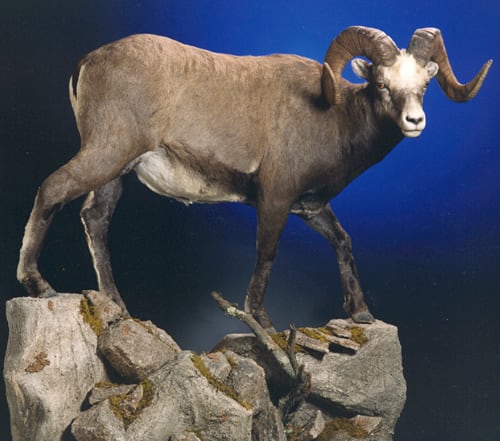
It shares the title of the largest body size of the snow sheep with the Kamchatka snow sheep. Soviet biologists report that typical horns measure 35 x 13 inches (89 x 33 cm). This race of snow sheep has the largest white area on the forehead of all snow sheep. There is a good deal of geographic variation in coloration and pattern, but essentially the summer coat is a light yellowish-gray that turns a grizzled grayish-brown in winter. Front of neck, shoulders and legs, dorsal stripe and tail are brown. Rump patch, belly and back of legs are whitish. Face, crown and back of neck are white, and a distinctive brown band crosses the face between eyes and nose. Snow sheep have compact, muscular bodies and relatively short legs (compared with other Asian sheep) that are adapted to climbing precipitous terrain. The coat is coarse and brittle, with each hair containing a sealed air pocket that serves as insulation. Hair texture is said to be quite different from that of North American sheep, being thick and woollike and becoming very long and shaggy in winter. The glands below the eyes are dark vertical skinfolds that protrude beyond the hair. Snow sheep have distinct rump patches, but do not have saddle patches, bibs or neck ruffs. The tail is broad and dark. The horns are homonymous, with the right horn growing in a right-handed spiral and left horn in a left-handed spiral, forming a tight curl of relatively small diameter. The horns are similar to those of the Dall and Stone sheep of North America, being brown or dark amber in color, fairly heavy and quite smooth, and with the frontal-orbital edge forming a prominent keel.
Taxonomy
- Kingdom
- Animalia
- Phylum
- Chordata
- Class
- Mammal
- Order
- Artiodactyla
- Family
- Bovidae
- Genus
- Ovis
- Species
- Snow sheep, nivicola
Habitat
They inhabit the upper forested zone to the limits of vegetation, a maximum altitude of 7,000 feet (2,000 meters). They prefer to winter on southern slopes. The living conditions are severe in the winter. Temperatures can fall down to −76 °F (−60 °C) with harsh winds and prevalent snowfalls. The combined range of all susbspecies of Snow sheep covers an area almost twice that of the argali's range.
Diet
Their diet consists primarily of grasses, but also of lichens, mosses, and willow sprouts.
Behavior
We know relatively little about snow sheep, but their habits are thought to be similar to those of Dall and Stone sheep. Like other pachyceriforms, snow sheep are classed as K-selected species, and have relatively low reproductive rates (one lamb after 170-180 days gestation) and long life spans (12-18 years). Females are believed to be sexually mature at 18 months, with the first lamb born at age two. Unlike other Asian sheep, they rarely have twins. Extremely agile and nimble, and able to move quickly over steep, uneven terrain. Within bachelor herds, a dominance hierarchy is formed based primarily on horn size. These hierarchies remain relatively stable, even in the breeding season, with larger males getting the majority of the mating rights. However, if two males have approximately equal sized horns, the dominant/subordinate relationship is decided in combat. Facing each other from a distance, they run towards each other with heads lowered, rearing up and crashing their horns together in an attempt to throw their rival off balance.
Hunting
The style of hunting will be spot and stalk backpack-style hunts, requiring good physical condition on the part of the hunter. The average size of Okhotsk Snow Sheep taken in the Khabarovsk region in Russia ranges from 34-35 inches (86-90 cm) to occasional rams up to 40 inches (102 cm). The hunting season is usually August-October with the optimum hunting period being from early August to mid September. A helicopter charter is needed in some hunting areas.
Conservation Status
A census in the mid 1980's estimated the population at around 10,000-12,000 individuals. More research and information on current statistics and conservation efforts is needed.