
Overview
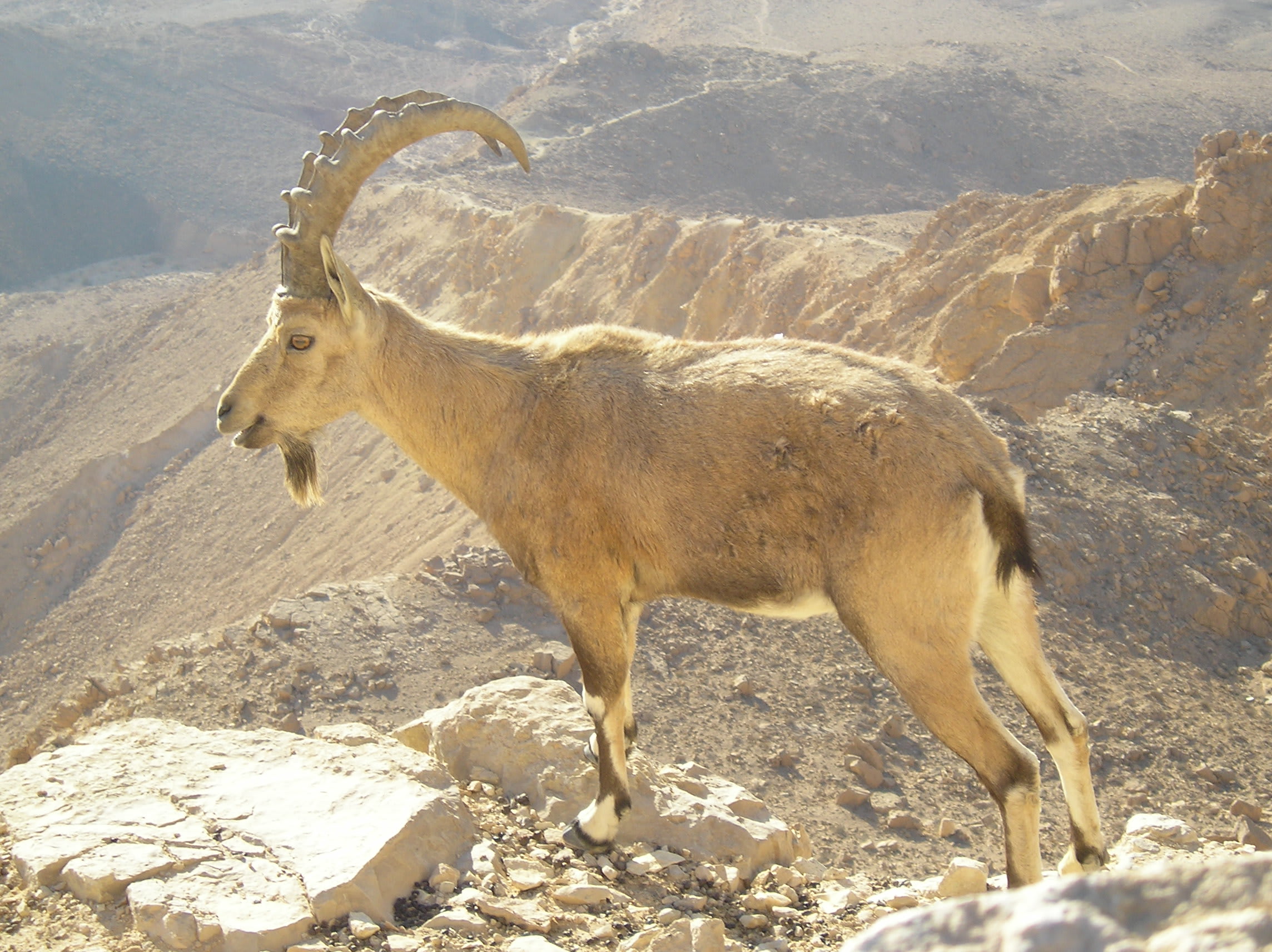
The Nubian ibex is smaller and more lightly built than the other species of true ibex (please see Asia for text on true ibex). The general color is yellowish-brown, with a dark dorsal stripe and dark markings on the chest. Underparts and chin are whitish. Legs have conspicuous black and white markings from the knees and hocks downward. The beard, while narrow, is long and dark. The short tail has a tuft of stiff black hairs. Ears are large, measuring 4-5 inches (10-12 cm) in length. There are scent glands under the tail. The male's horns are long, rather narrow, and scimitar-shaped, forming three-fourths of a circle. The front surface is flattened at an obtuse angle, so that the outer edge is rounded and the inner edge is sharp, and it is strongly cross-ridged. Females are smaller than males, lighter in color, beardless (except that very old females may have small beards), and grow horns only 5-6 inches (12-15 cm) in length. The Nubian ibex is distinguished from the Asian and Alpine ibexes by its narrower horns with their rounded outer edges, its white belly, and its contrasting black and white leg markings. It shares the characteristic of black and white leg markings with the walia ibex, but lacks the bony boss on the forehead.
Taxonomy
- Kingdom
- Animalia
- Phylum
- Chordata
- Class
- Mammal
- Order
- Artiodactyla
- Family
- Bovidae
- Genus
- Capra
Habitat
Arid desert hills and mountains from sea level to 6,000 feet (1,800 m). Distribution- The Red Sea Hills in Egypt and Sudan, and the mountains of Eritrea. Outside Africa, Nubian ibex are found in the Sinai Peninsula of Egypt, and in Israel, southwestern Jordan and the Arabian Peninsula. Formerly in Lebanon and Syria, but no longer to be found there. Introduced in the Tatra Mountains of eastern Europe, where it is said to have interbred with reintroduced Alpine ibex and introduced bezoar ibex; if true, this would be an unfortunate biological mistake. Nubian ibex have also been introduced on game ranches in several parts of the world.
Diet
Feeds early morning and late afternoon, but also at night when hunted hard. Eats grasses, bushes and foliage. Will stand on its hind legs to browse from bushes or trees. Has to survive with little or no water during much of the year.
Behavior
Lives in small mixed herds, though males are often solitary. Breeds mainly during October-November, usually with one kid (though often two) born 5-1/2 months later. Females go apart from the herd to give birth, taking refuge in caves or beneath overhangs. Longevity in captivity can exceed 10 years. Feeds early morning and late afternoon. Eyesight, hearing and sense of smell are exceptional. An extremely agile climber on the steepest rock.
Hunting
Hunting methods will vary based on topography of the specific area, but generally ibex are pursued through spot and stalk methods, glassing from vantage points and then pursuing a herd containing a desired male. Hunters should be in good physical condition and be prepared for precipitous terrain and potentially long shots.
Conservation Status
Listed as Vulnerable by the IUCN. However, there is limited current population data available, and this species is considered to be in decline. More research is needed.