
Overview
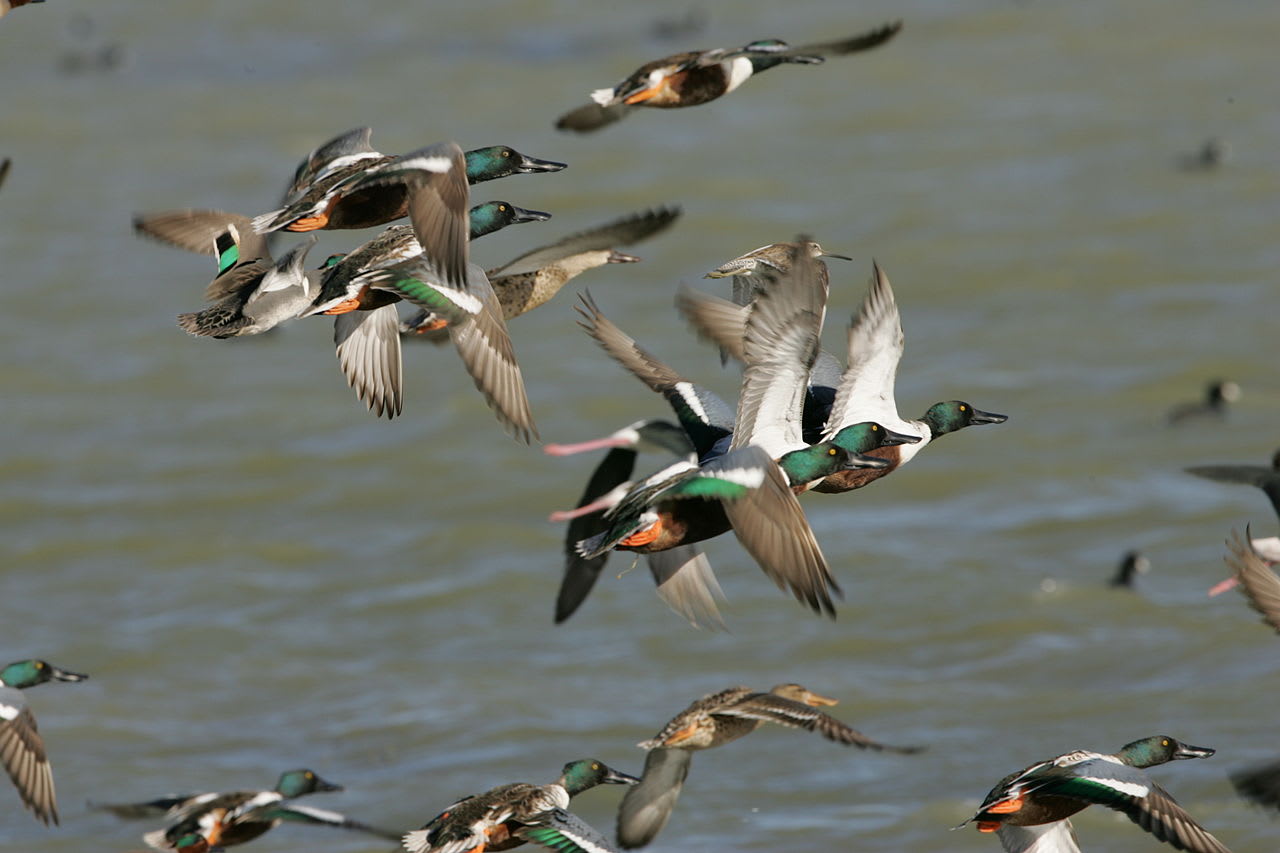
The Northern Shovler is a well-known duck based upon appearance. This North American species averages a length of 19 inches and an average weight of 1-½ lbs.. The Drake is the most noticeable one of the two by its coloration. The drake has a large noticeable black spoonbill that rounds out towards the tip of the bill. He has a green head and neck, with a white chest and breast with chestnut sides. They also have a prominent white line on their back with grey-blue shoulder patches that separate with a green-speculum on the feathers. The drake and hen also have bright colored orange feet. The hen on the other hand also a large orange spoonbill, but she has a light brownish color with white cream tip and colored feathers. The female’s bill will have small or large black spots. The Shovler spends most of its breeding season in parklands and mixed grasses. These water-skimming birds can be found in shallow marshes and feed on underwater life. While in their wintering ground they can be found in blackish coastal marshes and ponds. These birds while south feed on seeds, bulrushes, saw grasses, duckweed, and also small aquatic animals. What makes this species special is that it can skim across the water’s surface while filtering out vegetation by fluctuating water in and out of their bill.
Taxonomy
- Kingdom
- Animalia
- Phylum
- Chordata
- Class
- Bird
- Family
- Anatidae
- Genus
- Anas
- Species
- clypeata
Habitat
This is a bird of open wetlands, such as wet grassland or marshes with some emergent vegetation. It breeds in wide areas across Eurasia, western North America and the Great Lakes region of the United States. This bird winters in southern Europe, Africa, the Indian Subcontinent, northern South America, Malay Archipelago, Japan and other areas. Those wintering in the Indian Subcontinent make the taxing journey over the Himalayas, often taking a break in wetlands just south of the Himalaya before continuing further south to warmer regions. In North America it winters south of a line from Washington to Idaho and from New Mexico east to Kentucky, also along the Eastern Seaboard as far north as Massachusetts.
Diet
They use their highly specialized bill (from which their name is derived) to forage for aquatic invertebrates – a carnivorous diet. Their wide-flat bill is equipped with well-developed lamellae – small, comb-like structures on the edge of the bill that act like sieves, allowing the birds to skim crustaceans and plankton from the water's surface.
Behavior
The shoveler prefers to nest in grassy areas away from open water. Their nest is a shallow depression on the ground, lined with plant material and down. Hens typically lay about nine eggs. The drakes are very territorial during breeding season and will defend their territory and partners from competing males. Drakes also engage in elaborate courtship behaviors, both on the water and in the air; it is not uncommon for a dozen or more males to pursue a single hen. Despite their stout appearance, shovelers are nimble fliers.
Hunting
Typically hunted with a 12 ga shotgun. Shot size #2-4 is sufficient. Effectively hunted with decoys and calling. Dogs are used for bird retrieval. Steel shot is required for waterfowl in the United States.
Conservation Status
Listed as Least Concern by IUCN.