
Overview
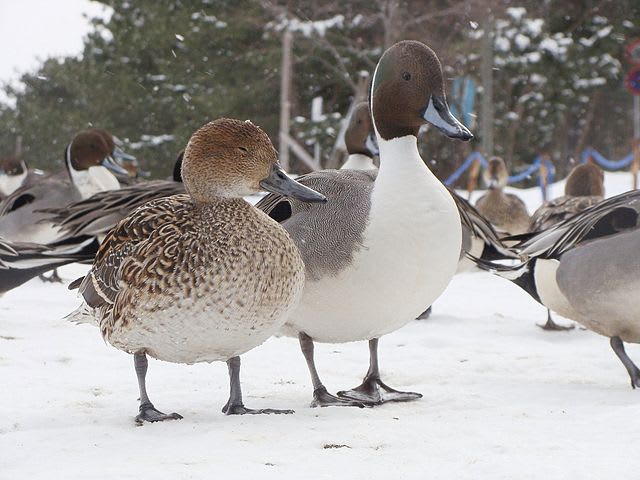
The Northern Pintail is a large bird known for drakes having large black sprigs. The drake can reach an average length of 25 inches and the hen can average 22 inches. The drake Pintail can weigh around 2.3 lbs. and the hen around 1.8 lbs.. The drake can be identified primarily due to its elongated neck and brown head with a white stripe that extends up. It has a white breast and belly with grey sides. It has 2 large sprig feathers and a bill that is blue-grey down the sides and a black strip down the center. The drake makes a trilling whistle noise like “Kee-wee-ee”. The hen is has a dark body with a grey head and lower back. She has a greyish black bill and makes a muffled quack. When breeding, these birds tend to be in tundra areas far from water. They concentrate themselves in shallow fresh estuaries or in the bay areas. The Pintails primary source of food comes from seeds, grain, and aquatic plants.
Taxonomy
- Kingdom
- Animalia
- Phylum
- Chordata
- Class
- Bird
- Family
- Anatidae
- Genus
- Anas
- Species
- acuta
Habitat
The northern pintail's breeding habitat is open unwooded wetlands, such as wet grassland, lakesides or tundra. In winter, it will utilise a wider range of open habitats, such as sheltered estuaries, brackish marshes and coastal lagoons. It is highly gregarious outside the breeding season and forms very large mixed flocks with other ducks.
Diet
The pintail feeds by dabbling and upending in shallow water for plant food mainly in the evening or at night, and therefore spends much of the day resting. Its long neck enables it to take food items from the bottom of water bodies up to 30 cm (12 in) deep, which are beyond the reach of other dabbling ducks like the Mallard. The winter diet is mainly plant material including seeds and rhizomes of aquatic plants, but the pintail sometimes feeds on roots, grain and other seeds in fields, though less frequently than other Anas duck like the Mallard. During the nesting season, this bird eats mainly invertebrate animals, including aquatic insects, molluscs and crustaceans.
Behavior
Both sexes reach sexual maturity at one year of age. The male mates with the female by swimming close to her with his head lowered and tail raised, continually whistling. If there is a group of males, they will chase the female in flight until only one drake is left. The female prepares for copulation, which takes place in the water, by lowering her body; the male then bobs his head up and down and mounts the female, taking the feathers on the back of her head in his mouth. After mating, he raises his head and back and whistles. The pintail walks well on land, and swims well. It has a very fast flight, with its wings slightly swept-back, rather than straight out from the body like other ducks.
Hunting
Typically hunted with a 12 ga shotgun. Shot size #2-4 is sufficient. Effectively hunted with decoys and calling. Dogs are used for bird retrieval. Steel shot is required for waterfowl in the United States.
Conservation Status
Listed as Least Concern by IUCN.