
Overview
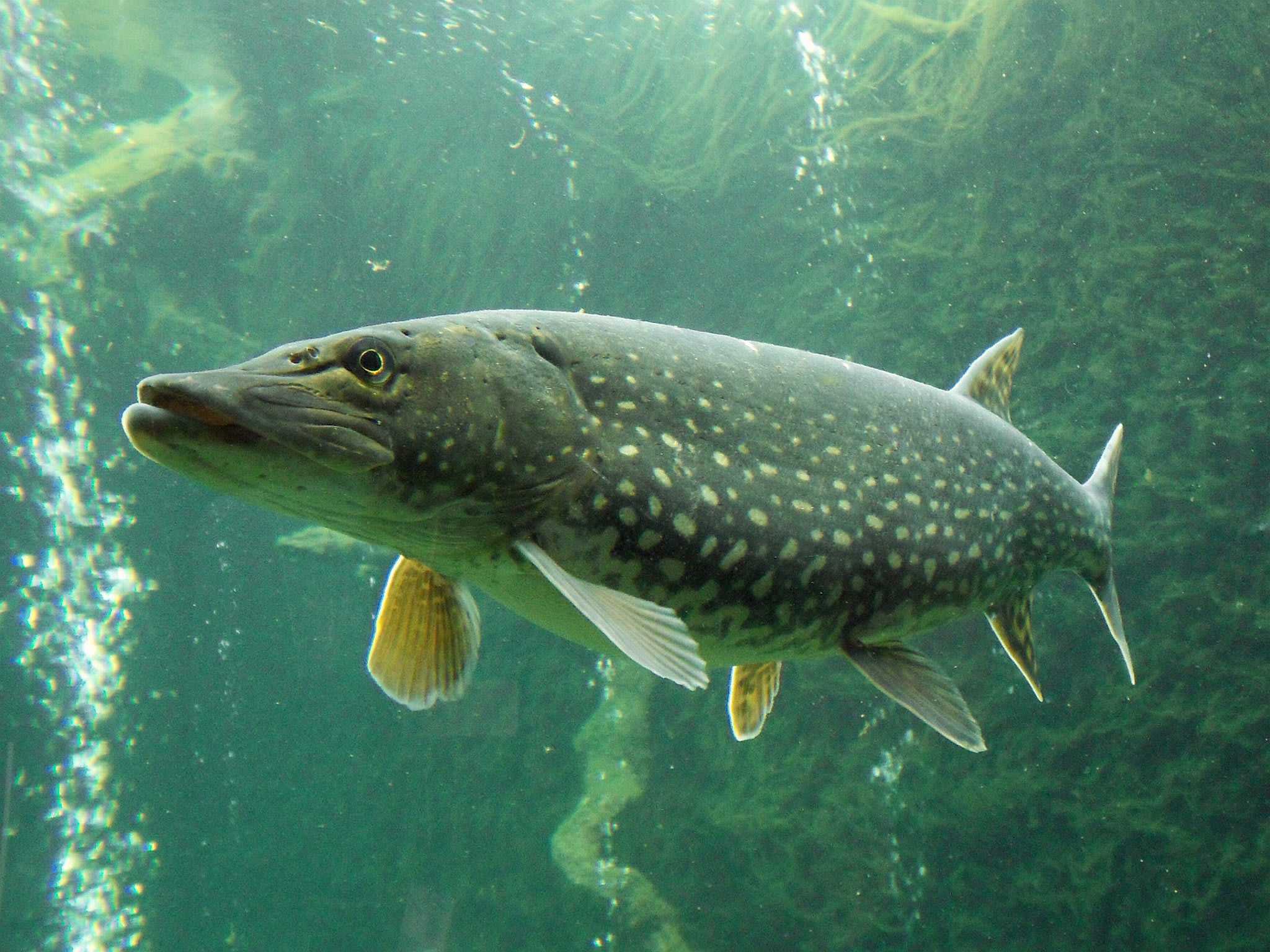
This fish is a long, sleek, predatory fish with a broad flat mouth, resembling a duck's bill. A single dorsal fin is located on the posterior portion of the body. In body shape the members of the pike group are all identical, but the Northern Pike can be distinguished from its relatives by three main features. Most noticeably the greenish or yellowish sides of the fish are covered with lighter colored oblong horizontal spots or streaks, whereas all other species have darker markings than the background color. The second distinction is the scalation pattern on the gill cover and cheek. In the northern pike the cheek is fully scaled, but the bottom half of the gill cover is scaleless. In the larger muskellunge, both the bottom half of the gill cover and the bottom half of the cheek are scaleless. In the smaller pickerels the gill cover and the cheek are both fully scaled. The third distinctive feature is the number of pores under each side of the lower jaw; usually 5 in the northern pike (rarely 3, 4 or 6 on one side), 6 9 in the muskellunge (rarely 5 or 10 on one side), and 4 in the smaller pickerels (occasionally 3 or 5 on one side only).
Taxonomy
- Kingdom
- Animalia
- Phylum
- Chordata
- Class
- Actinopterygii
- Order
- Perciformes
- Family
- Esocidae
- Genus
- Esox
- Species
- Lucius
Habitat
Pike are found in sluggish streams and shallow, weedy places in lakes, as well as in cold, clear, rocky waters.
Diet
90% of the northern pike's diet is smaller fish. When food is scarce, they also resort to cannibalism.
Behavior
The northern pike is a relatively aggressive species, especially with regards to feeding. Because of cannibalism when food is short, pike suffer a fairly high young mortality rate. Unlike species such as perch, pike undergo bursts of energy instead of actively chasing down prey. As such, a fair amount of inactive time occurs until they find prey.
Fishing
It is considered a delicious food fish. The flesh is sweet, white and flaky, but like other members of its genus, it sometimes has a “weedy” or “muddy” taste during the summer months. This taste is probably due to the skin mucus and can be eliminated by removing the skin prior to cooking. It has considerable commercial value and is an excellent sport fish. Pike are usually taken by trolling with large spoons, plugs or natural baits, but casting and still fishing are also frequently successful.
Conservation Status
Listed as Least Concern by IUCN.