
Overview
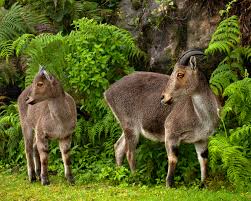
This subspecies is slightly larger than the Himalayan tahr subspecies. It is also distinguished by its short, stiff coat, close-set horns, and only one pair of teats in the female. There is no ruff. The general color is dark yellowish-brown with a dark dorsal streak and pale underparts. Old males are darker, with a black face and a conspicuous grizzled white patch on the back behind the ribs, from which they have acquired the name saddleback. Females and juveniles are more gray than males. The horns (both sexes) nearly touch at their bases, rise almost parallel, then turn backward and spread slightly. The outer surface is convex, the inner flat. Horns longer than 17 inches (43 cm) are reported from colonial times, but such were rare. The record is 17-1/2 inches (43.8 cm) (Rowland Ward, 1902). Stockley wrote in 1928 that anything over 14 inches (36 cm) was a good head. Females have slimmer and slightly shorter horns than males.
Taxonomy
- Kingdom
- Animalia
- Phylum
- Chordata
- Class
- Mammal
- Order
- Artiodactyla
- Family
- Bovidae
- Genus
- Nilgiritragus
Habitat
Spends most of its time in less rugged terrain than the Himalayan tahr, but needs nearby difficult ground for refuge. These animals prefer grass-covered hills at altitudes of 4,000-6,000 feet (1,200-1,800 m). Distribution- Southern India, from the Nilgiri Hills to the Anamalai Hills and southward along the Western Ghats.
Diet
Mainly a grazer.
Behavior
Active intermittently from dawn to dark. Gregarious, associating in herds of 10-30, and sometimes as many as 100. Adult males tend to either be solitary or in smaller herds with other adult males. Breeding appears to take place throughout cold weather, with single offspring born throughout the year.
Hunting
Not currently hunted.
Conservation Status
Habitat destruction and poaching have reduced this animal's range and population. The last population estimate was conducted in 1978, when 2,200 individuals were counted.