
Overview
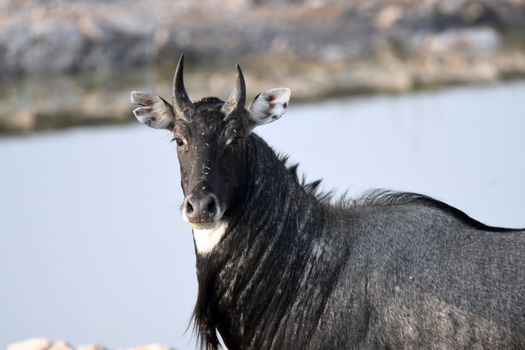
An odd-looking, horse-like antelope with high shoulders, low rump and very small horns. Overall color is iron-gray, with white markings on cheeks, ears and fetlocks. There is a tuft of stiff, black hairs on the throat and a mane on the neck and shoulders. The horns (males only) are short, straight and conical, with an extended lip in front. The female lacks horns and throat tuft, but is otherwise similar.
Taxonomy
- Kingdom
- Animalia
- Phylum
- Chordata
- Class
- Mammal
- Order
- Artiodactyla
- Family
- Bovidae
- Genus
- Boselaphus
Habitat
Adaptable to many habitats, including scrub forests, grasslands, dense woods, and cultivated lands.
Diet
Prefers grasses and herbs; woody plants are commonly eaten in the dry tropical forests of India. Studies suggest they may be browsers or mixed feeders in India, whereas they are primarily grazers in Texas. The nilgai can tolerate interference by livestock and degradation of vegetation in its habitat better than deer, possibly because they can reach high branches and do not depend on surface vegetation. The sambar deer and nilgai in Nepal have similar dietary preferences.Diets generally suffice in protein and fats.The protein content of the nilgai's should be at least seven percent. The nilgai can survive for long periods without water and do not drink regularly even in summer. However, a nilgai died in Dwarka (India) allegedly due to the heat wave and acute shortage of water. A 1994 study of the nilgai's diet in the Sariska Reserve revealed its preference for herbs and grasses; grasses became more important in the rainy season, while during winter and summer it fed additionally on flowers (Butea monosperma), foliage (Anogeissus pendula, Capparis sepiaria, Grewia flavescens and Zizyphus mauritiana), pods (Acacia nilotica, A. catechu and A. leucophloea) and fruits (Zizyphus mauritiana). Preferred grass species include Cenchrus species, Cynodon dactylon, Desmostachya bipinnata, Scirpus tuberosus and Vetiveria zizanoides. Woody plants eaten include Acacia nilotica, A. senegal, A. leucophloea, Clerodendrum phlomidis, Crotalaria burhia, Indigofera oblongifolia, Morus alba and Zizyphus nummularia; herbs favoured are Cocculus hirsutus, Euphorbia hirta and Sida rhombifolia. Seeds of Paspalum distichum occurred in the dung of nilgai most of the year; Acacia nilotica and Prosopis juliflora seeds were discovered in the dry season and those of Echinochloa crusgalli during the monsoon.
Behavior
The nilgai is diurnal (active mainly during the day). A 1991 study investigated the daily routine of the antelope and found feeding peaks at dawn, in the morning, in the afternoon and during the evening. Females and juveniles do not interact appreciably with males, except during the mating season. Groups are generally small, with ten or fewer individuals, though groups of 20 to 70 individuals can occur at times. In a 1980 study in the Bardiya National Park (Nepal), the average herd size was of three individuals; In a 1995 study in the Gir National Park (Gujarat, India), herd membership varied with season. However, three distinct groupings are formed: one or two females with young calves, three to six adult and yearling females with calves, and male groups with two to 18 members. Typically tame, the nilgai may appear timid and cautious if harassed or alarmed; instead of seeking cover like duikers it would flee up to 300 meters (980 ft)-or even 700 meters (2,300 ft) on galloping-away from the danger. Fights take place in both sexes and involve pushing their necks against each other or ramming into one another using horns.
Hunting
Nilgai are very challenging to hunt, with their keen eyesight, impressive hearing, great sense of smell, and an uncanny sense of approaching danger. Nilgai have a reputation for being extremely resilient and tough to put down. They have thick hides and leave little to no blood trail. Winchester Arms ranked the nilgai as the second toughest animal to kill, after the cape buffalo. The animal's hide covering its vitals is extra thick, not unlike that found on wild boar. Accuracy and power are essential when choosing your weapon. The populations of nilgai in India are so large that farmers in the states of Bihar, Chhattisgarh, Haryana, Madhya Pradesh, Maharashtra, Rajasthan and Uttar Pradesh have pleaded to the government to cull them. Nilgai herds raid and trample crop fields across these states, often causing food shortages. Farmers use live electric wires to guard their farms, which kills other animals as well. Farmers in Neemuch (Madhya Pradesh) went on a hunger strike in 2015 demanding compensation for the damage caused by nilgai. Although blackbuck cause a similar problem, the damage caused by them is significantly lower as they merely break off young shoots. A 1990 study suggested culling, building enclosures for the antelopes and fencing off agricultural areas as remedies for the menace. The governments of Bihar, Maharashtra and Uttarakhand have urged the Government of India to declare the nilgai as vermin; the proposal has been implemented in Bihar, where nilgai can now be hunted to minimise the damages incurred by locals. The Uttar Pradesh government has given farmers and firearm licence holders the right to cull the animals. However, animal rights activists in various parts of India were unhappy with the decision. Shivanshu K. Srivastava, a columnist and social activist, wrote that The culling of nilgais (blue bulls) in Bihar in July 2016 was so deplorable that it doesn't need any justification. The excuse given for this slew by the State government, the then environment minister Prakash Javadekar and the judiciary is so illogical that it mocks all the solutions available to stop the nilgais from destroying the farms. We live in the 21st century and culling is only the very last option we have. The farmers can either opt for fencing around the farmlands or if it's unaffordable, then the government can give ordinances to relocate them to the forests. The state governments have attempted other initiatives to curb the nilgai menace: in November 2015, the Rajasthan government came up with a proposal to allow shooting nilgai with non-lethal darts to inhibit fertilisation in their bodies, so as to regulate their increasing populations. As the name nilgai appeals to the religious sentiments of Hindus, the Government of Madhya Pradesh has sought to officially rename it as rojad (Hindi for forest antelope) and the Government of Haryana to rename it as roze in a bid to make their culling acceptable.
Conservation Status
Listed as Least Concern by IUCN.