
Overview
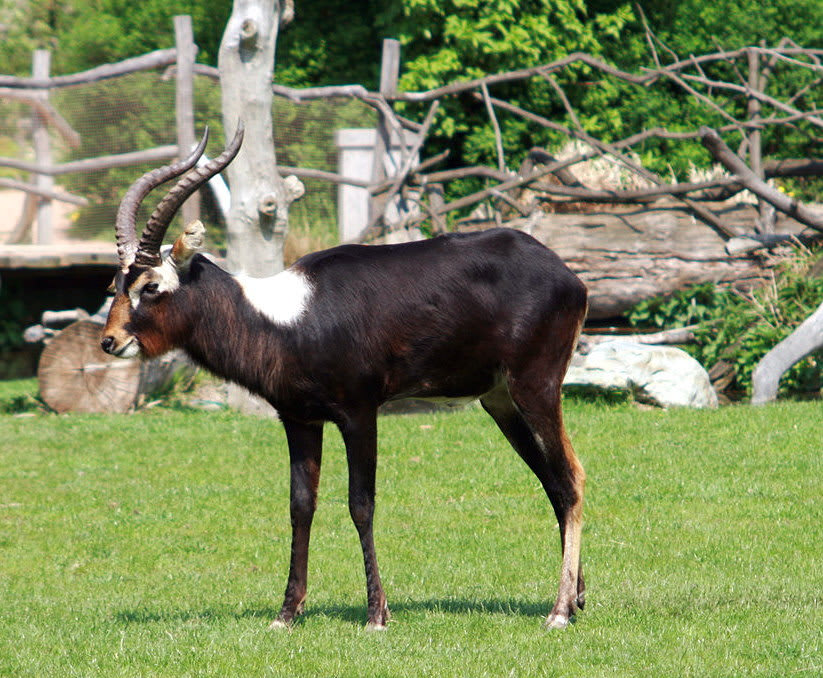
The Nile lechwe is a handsome, medium-sized antelope, appearing black at a distance, with a large white shoulder patch and very long, S-shaped horns. The body is somewhat smaller than that of the Common lechwe. General color is blackish brown, with shoulder patch, nape of neck, ears and underparts white. There are white markings around the eyes and on the muzzle and chin. The tail is long. The coat is rather long and rough. Hoofs are elongated and spread out, and the underside of the pasterns is hairless, which are adaptations to swampy habitat. Horns (males only) are strongly ringed, long and thin, and form a pronounced double or S-shaped curve. The female is smaller, without horns, chestnut fawn in color, and without the white shoulder patch or nape stripe.
Taxonomy
- Kingdom
- Animalia
- Phylum
- Chordata
- Class
- Mammal
- Order
- Artiodactyla
- Family
- Bovidae
- Genus
- Kobus
Habitat
Swamps. Distribution- Swamps of the White Nile, Bahr-el-Ghazal and Sobat rivers in southern Sudan, and swamps of the Baro and Ghilo rivers in extreme western Ethiopia.
Diet
Feeds on grasses and aquatic plants, drinks frequently.
Behavior
Gregarious, living in herds of 50 up to hundreds, or even more in loose bands. Males often form separate groups close to the main herd. Diurnal, but with most activity early and late in the day. Eyesight and hearing are good, sense of smell only fair. Swims well. Unable to run fast on dry land.
Hunting
Nile lechwe are handsome animals with beautiful horns. Depending on the water level, they may be found deep within a swamp, close to the edge, or sometimes even outside on dry ground where they can be approached much easier. A lechwe encountered outside a swamp, or even at the edge, is not difficult to take; however, the hunter misses the rich experience of a classic Nile lechwe hunt. For this, he must penetrate deep within the swamp on foot, wading waist-deep in murky water, attempting to balance atop floating islands of papyrus (and inevitably falling through), and being whipped by reeds and bitten by ants and leeches-all at high levels of temperature and humidity. Shooting a good Nile lechwe in the reeds is a difficult proposition, but, when a herd is eventually encountered on a piece of dry ground, it is not. The hunter should be in shape for the swamp, and is strongly advised to engage a local Dinka (who is taller and more surefooted than he) to carry his rifle, camera and anything else he would like to keep dry. (Sadly, the ongoing civil war in Sudan has prevented hunting there since 1983.)
Conservation Status
Listed as Endangered by IUCN, and inhabits war-torn regions.