
Overview
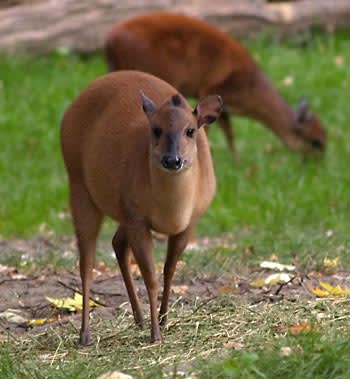
A relatively small duiker with a uniformly bright chestnut color and somewhat paler underparts. There is a tuft of long hairs on the head, which is usually chestnut and black, but is sometimes just chestnut. The chin and throat are whitish. The tail is reddish with a black and white tuft. The horns (both sexes) are thick and short, cone-shaped, strongly ridged at the base, and grow backward in the plane of the face. Females are similar to males, but are a little larger and have smaller horns.
Taxonomy
- Kingdom
- Animalia
- Phylum
- Chordata
- Class
- Mammal
- Order
- Artiodactyla
- Family
- Bovidae
- Genus
- Cephalophus
Habitat
Dense bush and forest. Distribution- Southeastern Tanzania, including the Selous Reserve; Malawi; the Nyika area of extreme northeastern Zambia; Mozambique; possibly in southeastern Zimbabwe; Swaziland; and the eastern Transvaal and Natal in South Africa.
Diet
These animals browse on plants and fallen fruit.
Behavior
More diurnal and less secretive than most forest duikers, thus more readily observed. Lives singly, in pairs, or in small family groups.
Hunting
Misclassification has sometimes been a problem with this animal in the SCI Record Book. Several Natal red duikers entered for the Record Book from South Africa have turned out, on examination, to be young bush duikers. The two species actually are very different in appearance. Hunters are advised to learn what a red duiker looks like before they hunt it.
Conservation Status
Listed as Least Concern by IUCN.