
Overview
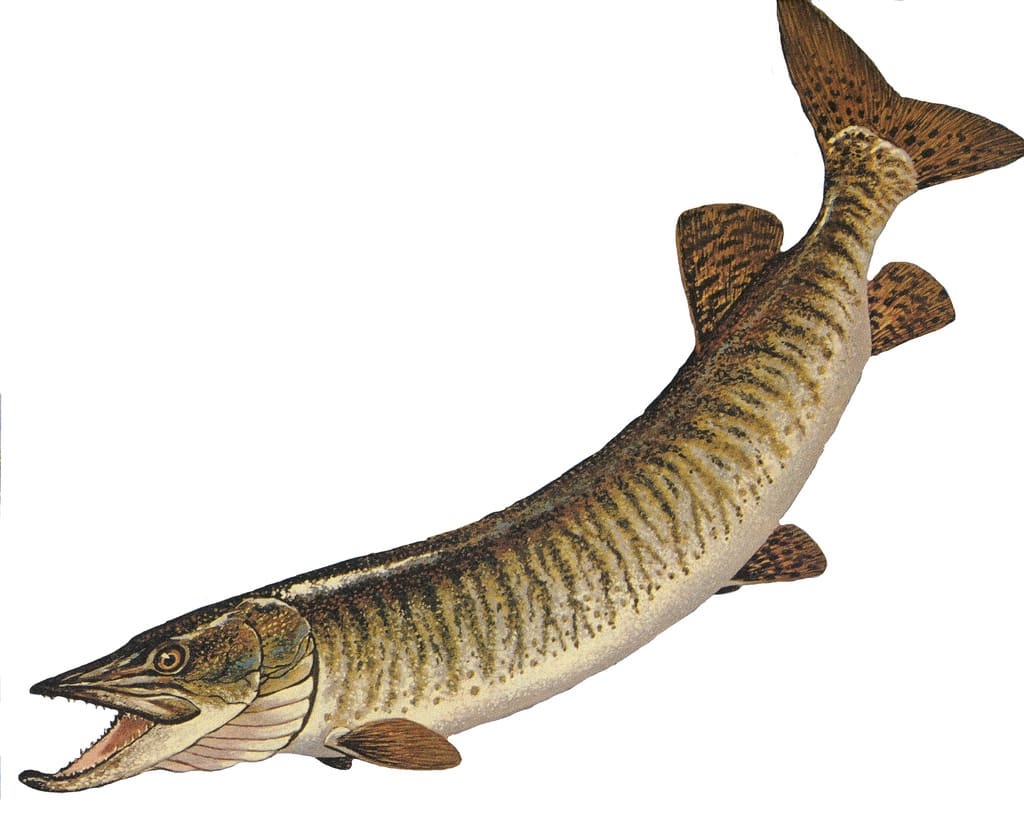
The Musky and all other species belonging to the Esox genus have a distinctive body that is long and sleek with a single dorsal fin located very far back near the tail. The pelvic (ventral) fins are located relatively far back on the belly, about half way between the pectoral fins and the tail, instead of directly under the pectoral fins. The mouth is large with the maxillae reaching back at least to the middle of the eyes, and broad, like a duck's bill, but full of teeth. It can be distinguished from the pike and the pickerels by several factors. It may be barred, spotted, or have no markings at all, but any markings that do occur will be darker than the background of the body. The northern pike, by comparison, has light colored, oblong spots against a darker body, and the chain pickerel (E. niger) has a unique chain like pattern on the sides. The redfin and grass pickerels (subspecies of E. americanus) look much more like the musky in their markings, but they only grow to about 15 in (38 cm) long. Another distinction occurs in the number of pores under the lower jaw. In the musky there are 6 9 along each side (rarely 5 or 10 on one side only). In the northern pike there are 5 along each side (rarely 3, 4, or 6 on one side only). In the pickerels, there are 4 along each side (occasionally 3 or 5 on one side only).
Taxonomy
- Kingdom
- Animalia
- Phylum
- Chordata
- Class
- Actinopterygii
- Order
- Perciformes
- Family
- Esocidae
- Genus
- Esox
- Species
- masquinongy
Habitat
It rarely ventures far from cover, and prefers shallow, heavily vegetated waters less than 40 ft (12 m) deep, usually along rocky shorelines in slow moving streams and larger rivers.
Diet
The diet is comprised of fish mostly, but they will also eat crayfish, frogs, ducklings, snakes, muskrats, mice, other small mammals, and small birds.
Behavior
They sometimes make small schools and mate in the late spring. A rock or sand bottom is preferred for spawning so the eggs do not sink into the mud and suffocate. The males arrive first and attempt to establish dominance over a territory. Spawning may last from five to 10 days and occurs mainly at night.
Fishing
This is a very popular game fish, and many anglers dedicate themselves almost exclusively to its pursuit. The musky is very elusive, and is not a common catch, even for those who constantly seek it out. The flesh is white and flaky and of excellent quality, but many caught by anglers are either mounted or released.
Conservation Status
Listed as Least Concern by IUCN.