
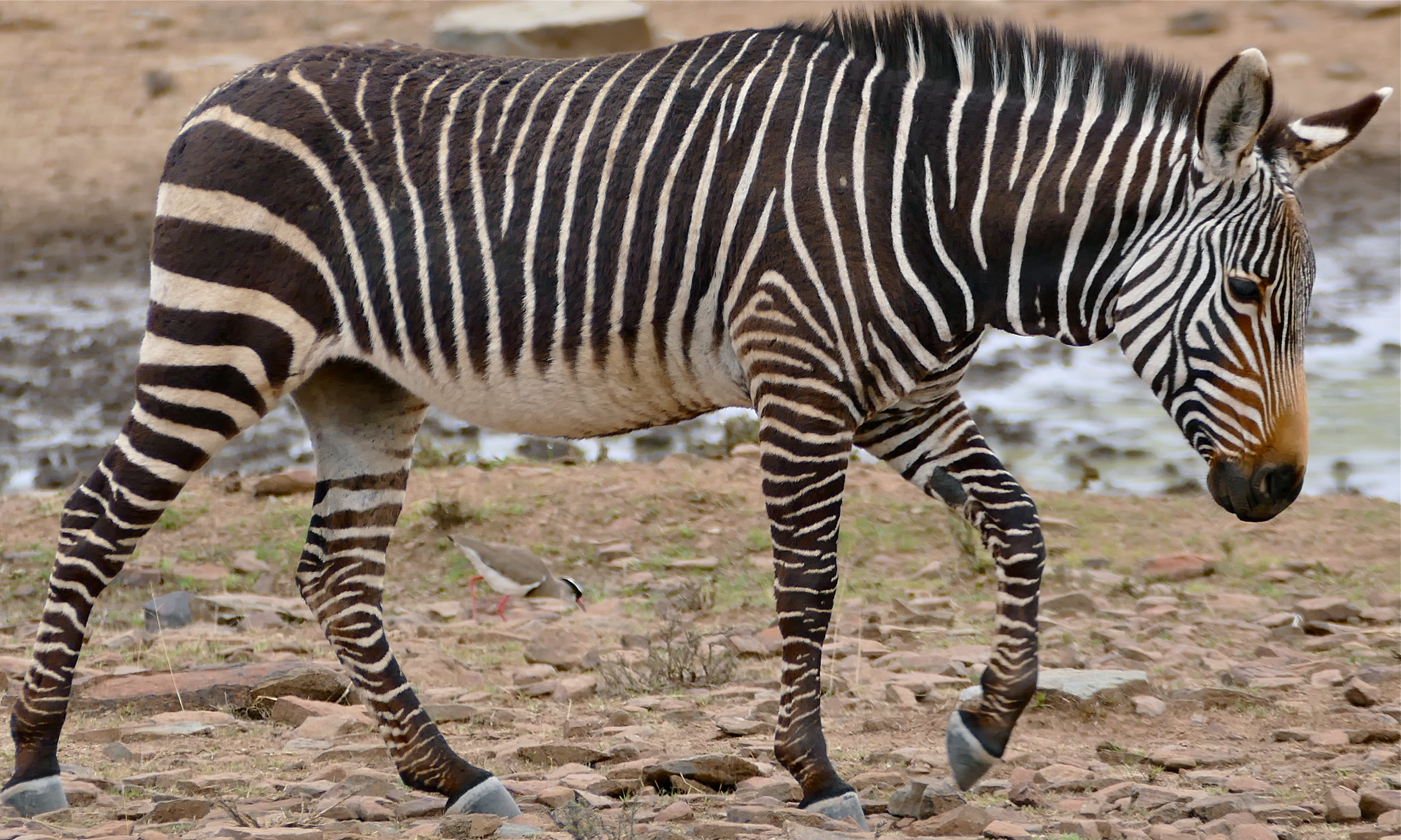
Taxonomy
- Kingdom
- Animalia
- Phylum
- Chordata
- Class
- Mammal
- Order
- Perissodactyla
- Family
- Equidae
- Genus
- Equus
Habitat
Mountain zebras primarily inhabit rugged, mountainous regions and hilly grasslands in southwestern Africa, such as Namibia and South Africa. They prefer areas with a mix of rocky outcrops, scrub, and open grasslands that offer both grazing opportunities and protection from predators. These environments are typically arid to semi-arid, with elevations ranging from 500 to 2000 meters.
Diet
Mountain zebras are herbivores that primarily graze on grasses and browse on shrubs, leaves, and bark. They feed mainly in the early morning and late afternoon to avoid the midday heat, helping them conserve energy in their arid habitats. Their feeding behavior includes selective grazing to maximize nutrient intake from low-quality forage.
Behavior
Mountain zebras live in small family groups led by a dominant stallion, with mares and foals, and they are highly territorial with stallions defending their group from rivals. They are diurnal, active during the day, and exhibit agile movements to navigate rocky terrain. These zebras communicate through vocalizations, body language, and mutual grooming, and they often form temporary associations with other groups during migrations.
Hunting
Mountain zebras are primarily hunted using spot-and-stalk methods in their rugged, mountainous habitats, requiring hunters to navigate rocky terrain on foot while glassing for groups; driven hunts may also be employed on private ranches for controlled encounters. Recommended calibers include .270 Winchester or larger, such as .300 Winchester Magnum, paired with a scoped rifle for precise shots at distances up to 200 yards, targeting the vital area behind the shoulder for quick, ethical harvests; essential equipment includes binoculars, camouflage clothing, and sturdy boots for the elevation changes. The best hunting season is during the dry winter months from May to September in the Southern Hemisphere, when zebras congregate near water sources, improving visibility and success rates. Trophy criteria focus on the animal's overall size, stripe quality, and mane, with records tracked by Safari Club International (SCI), where top specimens score based on skull measurements and hide integrity. Legal hunting is available in South Africa and Namibia, primarily on private game ranches and conservancies, where regulated programs ensure sustainable harvests; these hunts generate revenue that funds anti-poaching efforts and habitat restoration, contributing to the species' population recovery and exemplifying how managed hunting supports conservation under systems like those in Southern African conservancies.
Conservation Status
The IUCN classifies the mountain zebra as Vulnerable, with populations showing an increasing trend due to protected areas and conservation programs. Major threats include habitat loss from agriculture, competition with livestock, and poaching for meat and hides.