
Overview
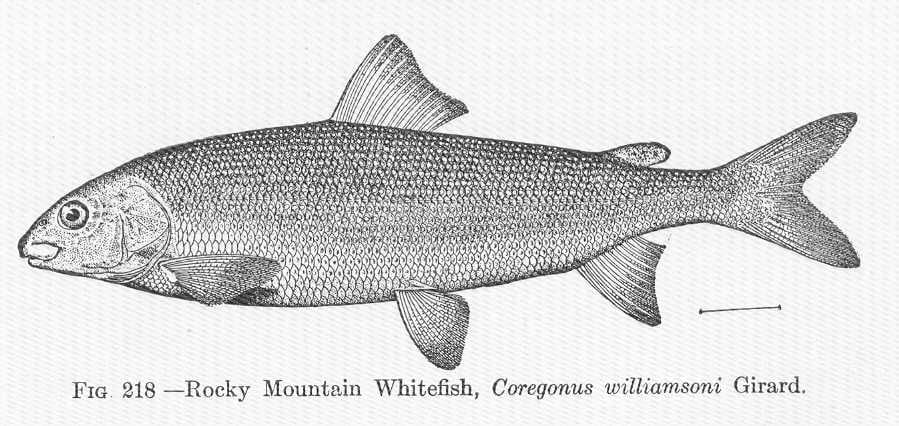
It has an adipose fin and an axillary process. The mouth, however, is slightly subterminal with the snout extending clearly beyond it. The body is silvery overall. The back is brownish to olive. The scales often have pigmented borders, especially on the back. The ventral and pectoral fins may have an amber hue in adults. The body is nearly cylindrical, but not quite as cylindrical as the body of the round whitefish.
Taxonomy
- Kingdom
- Animalia
- Phylum
- Chordata
- Class
- Actinopterygii
- Order
- Perciformes
- Family
- Salmonidae
- Genus
- Prosopium
- Species
- williamsoni
Habitat
Mountain whitefish primarily inhabit cold, clear rivers and streams in mountainous regions of western North America, such as the Rocky Mountains and Pacific Coast drainages. They prefer fast-flowing waters with gravel or rocky substrates that provide good oxygen levels and cover. These fish are often found in mid-elevation rivers and can tolerate a range of flows but avoid stagnant or warm waters.
Diet
Mountain whitefish mainly feed on aquatic insects like mayflies, caddisflies, and midges, as well as small crustaceans such as amphipods. They occasionally consume fish eggs or larvae, employing drift-feeding behavior in river currents. Feeding activity peaks during the day in riffles and runs.
Behavior
Mountain whitefish are schooling fish that form loose groups in open water, especially in larger rivers. They are primarily diurnal, actively feeding during the day and seeking shelter in deeper pools at night. These fish exhibit upstream migration for spawning and are not strongly territorial, often holding steady positions in currents to conserve energy.
Fishing
Though not as important as the lake whitefish, the mountain whitefish has gained some popularity as a sport fish and can be taken by fly fishing or casting with small baits. It provides a considerable winter fishery in places, particularly where steelheads are absent. The flesh is tasty and of good quality
Conservation Status
Listed as Not Evaluated by IUCN.