
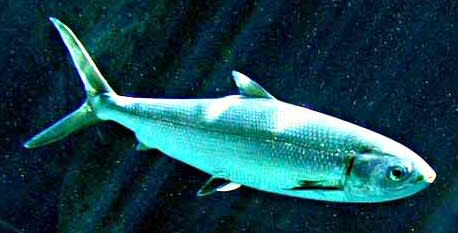
Taxonomy
- Kingdom
- Animalia
- Phylum
- Chordata
- Class
- Actinopterygii
- Order
- Cypriniformes
- Family
- Chanidae
- Genus
- Chanos
- Species
- chanos
Habitat
Milkfish primarily inhabit tropical and subtropical coastal waters, including estuaries, lagoons, and shallow marine environments with sandy or muddy bottoms. They tolerate a wide range of salinities, from full seawater to freshwater, and are commonly found in the Indo-Pacific region near coral reefs and mangroves. These areas provide ample food and protection from predators.
Diet
Milkfish mainly feed on algae, diatoms, and other phytoplankton, which they filter from the water or graze from surfaces. They are primarily herbivorous but may occasionally consume small invertebrates or detritus. Feeding activity peaks during the day in shallow waters.
Behavior
Milkfish are highly schooling fish, forming large groups that provide safety in numbers and facilitate feeding. They are active swimmers, often migrating between coastal areas and open ocean for spawning, and exhibit diurnal patterns with most activity during the day. They are generally peaceful and not territorial, making them easy to observe in schools.
Fishing
Anglers targeting milkfish, a prized species in tropical and subtropical waters, can employ effective techniques like trolling with live bait or lures that mimic small fish and plankton, or casting in shallow areas with dough balls or algae-based baits to entice their herbivorous feeding habits; recommended tackle includes medium-action rods with 20-30 lb test line for their powerful runs, paired with circle hooks to promote safe catch-and-release. Use baits such as chopped seaweed, small shrimp, or specially formulated pellets that replicate their natural diet of algae and phytoplankton for the best results. The prime season for milkfish fishing is during the warmer months from spring through fall in the Indo-Pacific regions like the Philippines, Hawaii, and Australia, with peak activity in the early morning or late afternoon when they school near the surface; target them in estuaries, lagoons, and shallow coastal waters with sandy or muddy bottoms, especially around coral reefs and mangroves, where they seek protection and food. Record sizes include the IGFA all-tackle world record of 43 pounds 7 ounces, showcasing the thrill of landing these fast-swimming giants. Conservation efforts benefit from angler-funded programs that support sustainable fisheries in these areas, with practices like slot limits and catch-and-release helping maintain stable populations, as milkfish are abundant and not evaluated by the IUCN, ensuring that recreational fishing continues to fund habitat restoration and protect vital waterways.
Conservation Status
Listed as Not Evaluated by IUCN.