
Overview
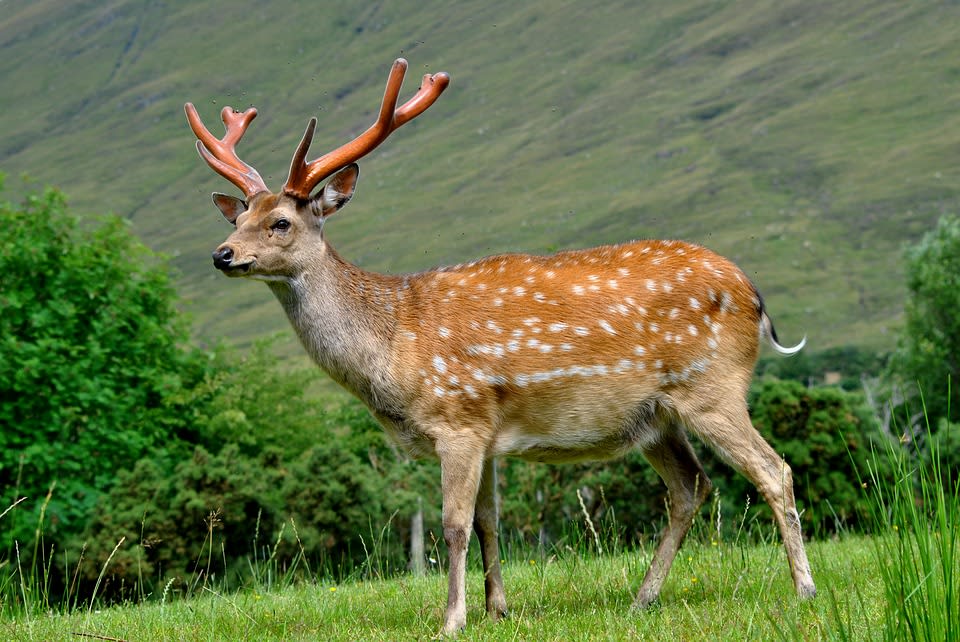
The summer coat is a rich brown-red with small white spots, and bluish-black on the neck in winter, with the spots barely visible. The antler velvet is reddish color.
Taxonomy
- Kingdom
- Animalia
- Phylum
- Chordata
- Class
- Mammal
- Order
- Artiodactyla
- Family
- Cervidae
- Genus
- Cervus
- Species
- Cervus nippon
Habitat
Forested regions, migrate up and down in elevation depending on the seasons. Distribution- England, Scotland, Czech Republic and Russia west of the Ural Mountains. Also kept in fenced game parks in various parts of Europe. Native to Manchuria.
Diet
Forest browser.
Behavior
The sika deer can be active throughout the day, though in areas with heavy human disturbance, they tend to be nocturnal. Seasonal migration is known to occur in mountainous areas, such as Japan, with winter ranges being up to 2,300 feet (700 m) lower in elevation than summer ranges.
Hunting
Refering to sika deer overall, they are excellent game animals in every respect. Stags can be called when rutting, but the caller must be within a stag's territory when doing so, because they are reluctant to cross their own territorial boundaries. Stags become aggressive during the roar, even toward man, and can be dangerous when wounded.
Conservation Status
Listed as Least Concern by IUCN. However this classification refers to the species as a whole, not this particular subspecie. Population estimates for this subspecie are not well-defined and more information is needed for current and future conservation efforts.