
Overview
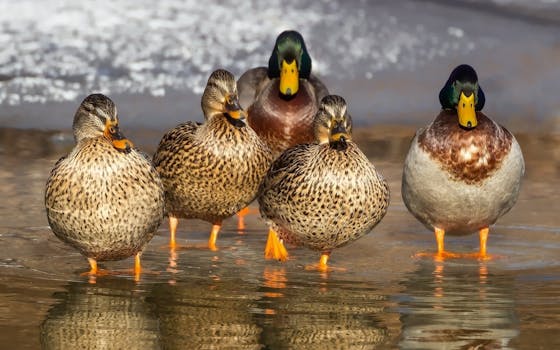
The Mallard is the most recognizable duck species known worldwide. Being one of the largest species of ducks, the drake can reach an average length of 25 inches and the hen around 23 inches. The drake can weigh upwards of around 2.8 lbs. and the hen can weigh around 2.4 lbs.. The green head and white stripe that separates the green head from the chestnut-brown chest can easily identify the drake. The speculum of this bird is a violet-bluish color. The bill is yellow and the legs have an orange coloration. The drake makes a prominent whistle call that is deep and raspy like saying “dweeet”. The hen is brownish colored with a violet speculum as well. The hen has a black line that runs through its eye with a orange specked beak and orange feet. The hen makes the most common duck sound, or a quack. Of most dabbling ducks the Mallard is one of the last birds to migrate for wintering. They can be found in agricultural fields, wetlands, and small puddle waters. These large birds feed upon seeds, aquatic plants, and aquatic animals.
Taxonomy
- Kingdom
- Animalia
- Phylum
- Chordata
- Class
- Bird
- Family
- Anatidae
- Genus
- Anas
- Species
- platyrhynchos
Habitat
Their breeding areas consist of the northern third of the United States and into Canada. The majority of Mallards can be found in the Prairie Pothole Region in the Dakotas and Canada. Migration routes run from their breeding grounds to the Gulf of Mexico. These birds can prominently be found in the Mississippi flyway.
Diet
The majority of the mallard's diet seems to be made up of gastropods, invertebrates (including beetles, flies, lepidopterans, dragonflies, and caddisflies), crustaceans, worms, many varieties of seeds and plant matter, and roots and tubers.
Behavior
Mallards usually form pairs (in October and November in the Northern Hemisphere) until the female lays eggs at the start of the nesting season, which is around the beginning of spring. At this time she is left by the male who joins up with other males to await the moulting period, which begins in June (in the Northern Hemisphere). During the brief time before this, however, the males are still sexually potent and some of them either remain on standby to sire replacement clutches (for female mallards that have lost or abandoned their previous clutch, replacement clutch) or forcibly mate with females that appear to be isolated or unattached regardless of their species and whether or not they have a brood of ducklings.
Hunting
Typically hunted with a 12 ga shotgun. Shot size #2-4 is sufficient. Effectively hunted with decoys and calling. Dogs are used for bird retrieval. Steel shot is required for waterfowl in the United States.
Conservation Status
Listed as Least Concern by IUCN.