
Taxonomy
- Kingdom
- Animalia
- Phylum
- Chordata
- Class
- Actinopterygii
- Order
- Perciformes
- Family
- Lutjanidae
- Genus
- Lutjanus
- Species
- mahogoni
Habitat
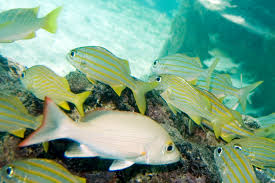
Mahogany snappers primarily inhabit coral reefs, rocky substrates, and mangrove areas in tropical and subtropical waters. They prefer depths from 10 to 100 meters in the Western Atlantic, including the Florida Keys, Gulf of Mexico, and Caribbean Sea. These environments provide ample cover and food sources.
Diet
Mahogany snappers feed mainly on small fish, crustaceans like shrimp and crabs, and mollusks such as snails and cephalopods. They are active predators that hunt during the day, often ambushing prey from hiding spots in reefs. Feeding behavior includes quick strikes and schooling to corral smaller fish.
Behavior
Mahogany snappers are schooling fish that form groups around coral reefs for protection and feeding. They are diurnal, active during the day and resting at night, and exhibit territorial behavior when defending feeding areas. They are cautious and may flee quickly when threatened, making them challenging to approach.
Fishing
Target Mahogany snapper with effective bottom fishing techniques, such as dropping baits near structure or using light jigging to mimic their prey, in the coral reefs, rocky substrates, and mangrove areas of the Western Atlantic, including the Florida Keys, Gulf of Mexico, and Caribbean Sea, at depths of 10 to 100 meters for the best results. Use medium-action rods with 10-20 lb test line, circle hooks, and reels suited for light tackle to handle their cautious strikes, paired with baits like live shrimp, cut bait, or small jigs and lures that imitate small fish and crustaceans. The prime season runs from spring through fall during their spawning periods, with daytime hours offering the highest activity for these diurnal predators. Anglers can aim for impressive sizes, with fish typically reaching 20-40 cm and up to 60 cm, while the IGFA all-tackle world record is 12 pounds 8 ounces, caught in Florida, highlighting the thrill of the sport. These fisheries are managed through angler-supported programs that fund habitat protection and stocking efforts, with regulations like slot limits and catch-and-release in certain areas serving as proven tools to maintain stable populations, as evidenced by their Least Concern status from the IUCN, ensuring recreational fishing continues to bolster conservation in tropical waterways.
Conservation Status
Listed as Least Concern by IUCN.