
Overview
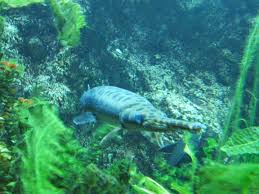
This gar is generally distinguished from other gars by its longer, more slender body, and especially by its longer, narrower beak (10 times as long as it is wide at its narrowest point). The nostrils are located in a small, bulbous fleshy growth at the very tip of the upper jaw. The bony, diamond shaped ganoid scales of the gars overlap to form a protective armor on the body that has been known to deflect arrows. The gar have been present in North America for about 100 million years
Taxonomy
- Kingdom
- Animalia
- Phylum
- Chordata
- Class
- Actinopterygii
- Order
- Perciformes
- Family
- Lepisosteidae
- Genus
- Lepisosteus
- Species
- osseus
Habitat
Longnose gar are typically associated with backwaters, low inflow pools and moderately clear streams. They often do very well in man-made impoundments.
Diet
They feed primarily on insect larvae and small crustaceans such as water fleas. Fish appear in the diet very early.
Behavior
Spawning activity occurs as early as April, in shallow riffle areas. Females, typically the larger sex, may be accompanied by one or many males. Although nests are not prepared, gravel is swept somewhat by the spawning action itself. Each female may deposit a portion of her eggs at several different locations. The adhesive eggs are mixed in the gravel, hatching in six to eight days. Yolk-sac fry have an adhesive disc on their snouts by which they attach themselves to submerged objects until the yolk sac is absorbed.
Fishing
Although edible, it is not popular, and the eggs are poisonous, causing severe illness in humans and sometimes death in smaller animals and birds. Only fish seem to be able to consume them without harm. Longnose gar may be captured by entangling the teeth in nylon threads, or by bowfishing. In Texas, specimens in excess of 80 pounds have been landed using a bow and arrow.
Conservation Status
Listed as Least Concern by IUCN.