
Overview
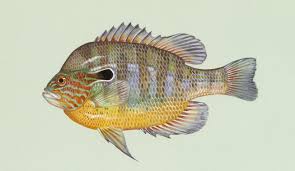
Longear sunfish are quite colorful. Males are often bright orange or scarlet, and the head and fins usually have turquoise markings. Dorsal and anal fins, and their associated spines, are similar to those of redear sunfish.
Taxonomy
- Kingdom
- Animalia
- Phylum
- Chordata
- Class
- Actinopterygii
- Order
- Cypriniformes
- Family
- Centrarchidae
- Genus
- Lepomis
- Species
- megalotis
Habitat
Longear sunfish are primarily found in small streams and creeks. Like other sunfish they are often associated with vegetation, avoiding strong currents by inhabiting pools, inlets, and waters off the main stream channel.
Diet
Insects and even small fish become part of the diet as fish approach adulthood.
Behavior
Spawning occurs throughout late spring and early summer. Males scoop nests out of gravel bars. Females are enticed to lay their eggs on a particular nest by a male who swims out to meet her, swimming around her rapidly and displaying his brilliant spawning colors. After the eggs have been laid, males chase the females away and guard the nest vigorously despite their small size, chasing away all intruders. Males may continue to guard the nest for a week or more after hatching, until larvae have dispersed.
Fishing
Because of its small size, the species' importance to anglers derives in three ways. Since they are relatively easy to capture with simple, natural baits such as earthworms, longears are an important species for young anglers with little experience. Like most sunfish, they provide more than enough fight for their small size. Longears may feed on the surface, providing the fly fishermen with a challenge, and finally, they are often a prized bait fish for trotliners.
Conservation Status
Listed as Least Concern by IUCN.