
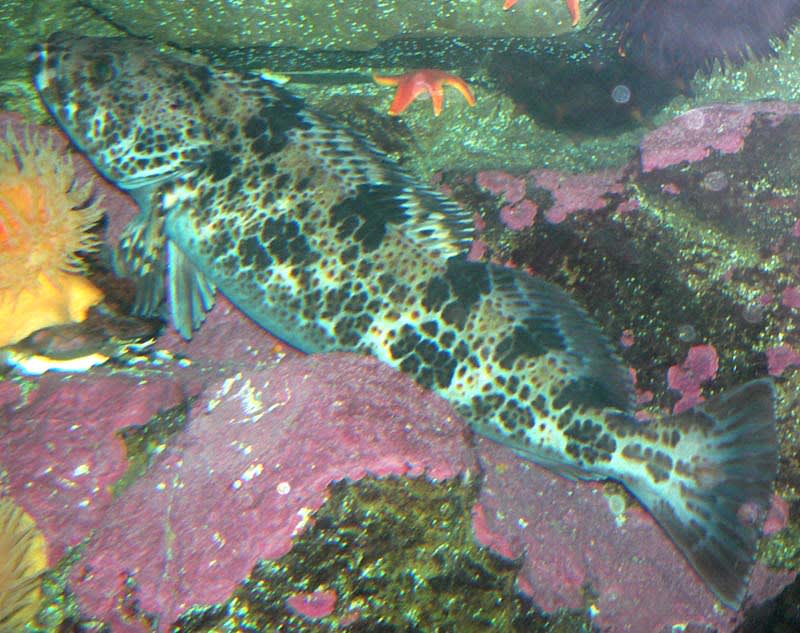
Overview
It is recognized by a combination of characteristics. The mouth is large and slightly upward directed with a projecting lower jaw; the maxillae (upper jawbones) extend back beyond the posterior margin of the eyes. The large canine teeth are responsible for the genus name Ophiodon, derived from the Greek words “ophis” (snake) and “odons” (tooth). There is a single, continuous dorsal fin with a dip between the spiny anterior portions and soft rayed posterior part. The pectoral fins are large and fan like. The head and body are covered with small, smooth, cycloid scales, giving the fish a smooth look. Color is highly variable with habitat and may be almost any shade of brown, black, gray, blue or green with darker mottling.
Taxonomy
- Kingdom
- Animalia
- Phylum
- Chordata
- Class
- Actinopterygii
- Order
- Perciformes
- Family
- Hexagrammidae
- Genus
- Ophiodon
- Species
- elongatus
Habitat
Juveniles may be caught near kelp beds and rocky areas. Adults tend to remain in deeper water, and have been taken as deep as 1,381 ft (421 m), although they are most common at depths less than 350 ft (106 m).
Diet
They are voracious feeders that readily devour flounders, hake, herring, rockfish, cod, and even their own species, as well as crustacean and octopus.
Behavior
Lingcod are solitary ambush predators that lie in wait among rocks and crevices to surprise prey. They exhibit territorial behavior, especially during spawning when males guard nests aggressively. They are most active during the day and prefer to remain in the same area for extended periods.
Fishing
They are most commonly taken on heavy jigs fished in 30 700 ft (9 213 m) of water. They have been known to chase down and inhale hooked salmon and other fish being played by anglers, often refusing to let go until lifted out of the water. Lingcod are highly regarded sport fish and food fish.
Conservation Status
Listed as Not Evaluated by IUCN.