
Overview
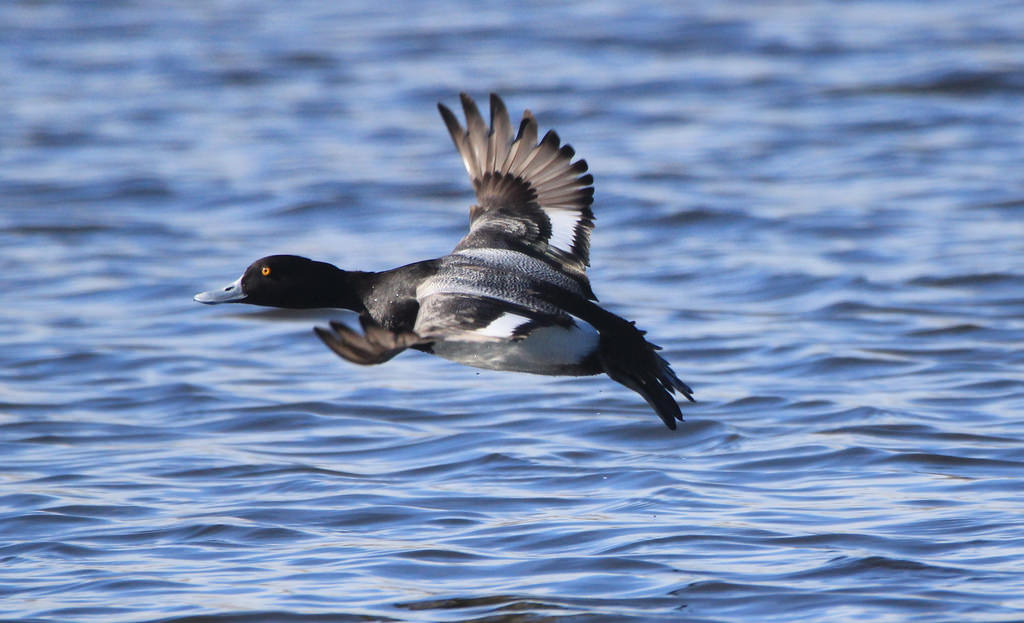
The adult males (drakes) in alternate plumage have a black, iridescent head and a small tuft at the hindcrown, a black breast, a whitish-grey back and wings with darker vermiculations and black outer and greyish-brown inner primary remiges. The underparts are white with some olive vermiculations on the flanks, and the rectrices and tail coverts are black. Adult females (hens) have a white band at the base of the bill, often a lighter ear region, and are otherwise dark brown all over, shading to white on the mid-belly. Lesser scaup are often hard to distinguish from the greater scaup when direct comparison is not possible, but in North America a large scaup flock will often have both species present. Females, juveniles and drakes in eclipse plumage are hard to identify; there is considerable overlap in length between the two species, but greater scaup are usually noticeably more bulky. Lesser scaup females and immatures tend to have less white around the bill, but this too varies considerably between individual birds.
Taxonomy
- Kingdom
- Animalia
- Phylum
- Chordata
- Class
- Bird
- Family
- Anatidae
- Genus
- Aythya
- Species
- affinis
Habitat
They nest in a sheltered location on the ground near water, usually among thick vegetation such as sedges and bulrushes, sometimes in small loose groups and not rarely next to colonies of gulls or terns; several females may deposit eggs in a single nest. The drakes court the hens in the winter quarters; pairs form shortly before and during the spring migration. When nesting starts, the males aggregate while they moult into eclipse plumage, leaving the task of incubation and raising the young to the females alone.
Diet
They forage mainly by sifting through the bottom mud, usually after diving and swimming underwater, occasionally by dabbling without diving. They mainly eat mollusks such as mussels and clams, as well as seeds and other parts of aquatic plants like sedges and bulrushes (Cyperaceae), pondweeds, widgeon-grass (Ruppia cirrhosa), wild celery (Vallisneria americana) or wild rice (Zizania). In winter, but less so in summer, other aquatic animals—crustacean, insect and their larvae and small fishes—form an important part of their diet.
Behavior
These birds are not very vocal, at least compared to dabbling ducks. Hens give the namesake discordant scaup, scaup call; in courtship drakes produce weak whistles. Hens vocalize more often than those of the greater scaup—particularly during flight—but their call is weaker, a guttural brrtt, brrtt. These birds migrate south (mostly via the Central and Mississippi Flyways) when the young are fledged and return in early spring, usually arriving on the breeding ground in May. Lesser scaup typically travel in flocks of 25–50 birds and winter mainly on lakes, rivers and sheltered coastal lagoons and bays between the US–Canada border and northern Colombia, including Central America, the West Indies and Bermuda. Wintering lesser scaup are typically found in freshwater or slightly brackish habitat and unlike greater scaup rarely are seen offshore when unfrozen freshwater habitat is available. They may even spend the winter on lakes in parks, as long as they are not harassed, and will occur even on smallish Caribbean islands such as Grand Cayman.
Hunting
Typically hunted with a 12 ga shotgun. Shot size #2-4 is sufficient. Effectively hunted with decoys and calling. Dogs are used for bird retrieval. Steel shot is required for waterfowl in the United States.
Conservation Status
Listed as Least Concern by IUCN.