
Overview
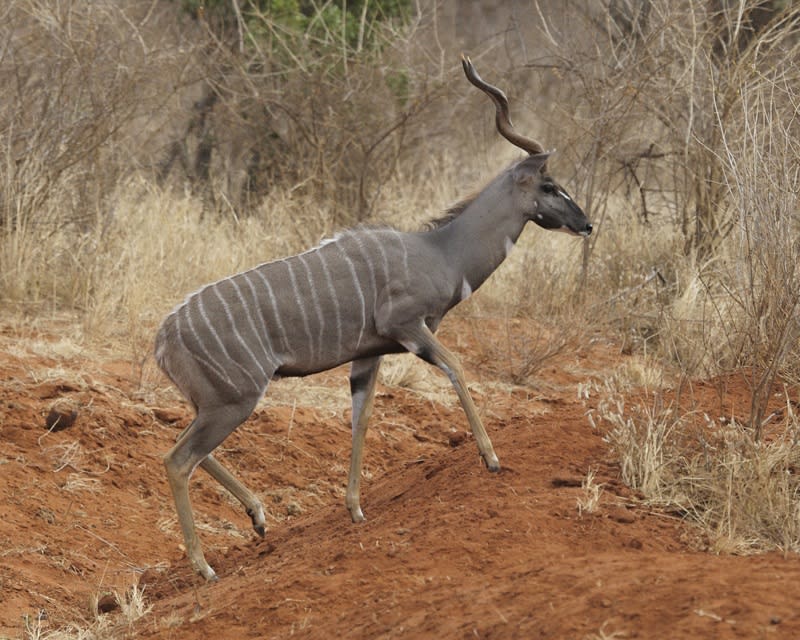
The lesser kudu is a graceful, slender, medium-sized antelope with long, spiraling horns. It has a straight back, large ears and a bushy tail. It is grayish brown in color (becoming bluish gray in older animals), with 11-13 well-defined white stripes on each side, an incomplete white chevron between the eyes, and white patches on throat and neck. Its short, brown mane continues as a white dorsal crest. Only the males have horns, and these are keeled, with 2-3 close spirals, and diverge only moderately. The female is slightly smaller, without horns, and is a rufus tan in color.
Taxonomy
- Kingdom
- Animalia
- Phylum
- Chordata
- Class
- Mammal
- Order
- Artiodactyla
- Family
- Bovidae
- Genus
- Tragelaphus
Habitat
Semi-arid country with thick bush. Can live in much drier habitat than the Greater kudu.
Diet
Mainly a browser of leaves and twigs. Grazes occasionally. Drinks daily when available, but can go long periods without water.
Behavior
Lives singly, in pairs, or in small family groups. Adult males associate with females only when breeding. Not territorial. Largely nocturnal, feeding during late evening and early morning and hiding by day in cover. Hearing and sense of smell are very good, eyesight is fair. A good jumper. Shy and alert.
Hunting
Considered by some to be more difficult to hunt than the Greater kudu. They can be hunted by spot & stalk methods and are often very hard to spot, and once alerted, are usually never seen again. They are often seen working the edge habitat and won't be found too far from cover. Once bumped from a safari vehicle or hunting party, they are very hard to approach.
Conservation Status
Listed as Near Threatened by IUCN.