
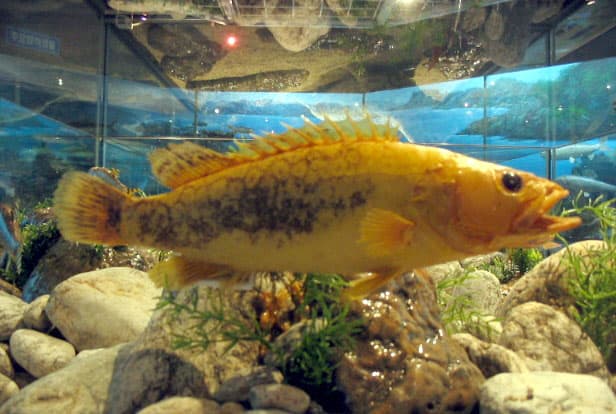
Taxonomy
- Kingdom
- Animalia
- Phylum
- Chordata
- Class
- Actinopterygii
- Order
- Perciformes
- Family
- Percichthyidae
- Genus
- Siniperca
- Species
- scherzeri
Habitat
This species primarily inhabits freshwater rivers, streams, and lakes in East Asia, including the Korean Peninsula and parts of China. They prefer areas with rocky or vegetated substrates and moderate water flow, often found in deeper pools to avoid strong currents.
Diet
Leopard mandarin fish are carnivorous, feeding mainly on smaller fish, insects, and crustaceans. They employ an ambush hunting strategy, lying in wait among rocks or vegetation, and are most active during dawn and dusk when they strike quickly at prey.
Behavior
These fish are solitary and territorial, often defending a specific area in their habitat from intruders. They are primarily nocturnal or crepuscular, hiding during the day and becoming more active at night to hunt. During breeding, males exhibit aggressive behavior to protect nests and eggs.
Fishing
Anglers targeting the Leopard mandarin fish, a carnivorous species prized for both sport and food in East Asia, should focus on ambush-style techniques like casting soft plastics, jigs, or live baits such as small fish, insects, or crustaceans near rocky substrates, vegetation, or deeper pools in freshwater rivers and streams of the Korean Peninsula, China, and South Korea to mimic its natural hunting behavior. Use light to medium spinning tackle with 6-10 pound test line, a sensitive rod for detecting subtle strikes, and hooks sized 1/0 to 4/0 to handle fish up to 60 centimeters in length and weights reaching 1 pound 8 ounces, ensuring you can manage their territorial fights effectively. The best season is spring during spawning when water temperatures rise, with peak activity at dawn and dusk for higher success rates; always check local regulations in regions like the Nakdong River for effective management tools that promote sustainable populations. As a Data Deficient species per IUCN, recreational fishing supports conservation through license fees that fund habitat restoration and stocking programs, emphasizing catch-and-release practices to maintain healthy waterways and ensure long-term population stability.
Conservation Status
Listed as Data Deficient by IUCN.