
Overview
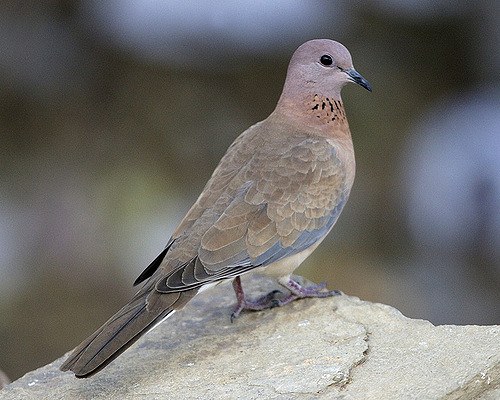
The laughing dove is a long-tailed, slim pigeon. It is pinkish brown on the underside with a lilac tinged head and neck. The head and underparts are pinkish, shading to buff on the lower abdomen. A chequered rufous and grey patch is found on the sides of the neck and are made up of split feathers. The upper parts are brownish with a bluish-grey band along the wing. The back is uniform and dull brown in the Indian population. The African populations senegalensis and phoenicophila have a bluish grey rump and upper tail coverts but differ in the shades of the neck and wing feathers while aegyptiaca is larger and the head and nape are vinous and upper wing coverts are rufous. The tail is graduated and the outer feathers are tipped in white. The sexes are indistinguishable in the field. Young birds lack the chequered neck markings. The legs are red. The populations vary slightly in plumage with those from more arid zones being paler. Abnormal leucistic plumages have been noted.
Taxonomy
- Kingdom
- Animalia
- Phylum
- Chordata
- Class
- Bird
- Family
- Columbidae
- Genus
- Streptopelia
- Species
- senegalensis
Habitat
It is a common and widespread species in scrub, dry farmland and habitation over a good deal of its range, often becoming very tame.
Diet
Seeds, mainly of grasses, other vegetable matter and small ground insects such as termites and beetles.
Behavior
The species is usually seen in pairs or small parties and only rarely in larger groups. Larger groups are formed especially when drinking at waterholes in arid regions. Small numbers assemble on trees near waterholes before flying to the water's edge where they are able to suck up water like other members of the pigeon family. They are fairly terrestrial, foraging on the ground in grasslands and cultivation. Their flight is quick and direct with the regular beats and an occasional sharp flick of the wings which are characteristic of pigeons in general.
Hunting
More information is needed.
Conservation Status
Listed as Least Concern by IUCN.