
Overview
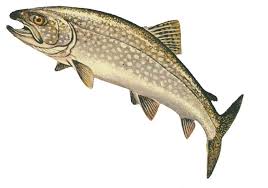
It is classified taxonomically with the chars (genus Salvelinus), although some scientists prefer to place it in a genus of its own (Cristivomer). Like other chars it has white leading edges on all the lower fins and light colored spots on a dark background, instead of the dark spots on a light background which is characteristic of salmons and trouts. The body is typically grayish to brownish with white or nearly white spots which extend onto the dorsal, adipose and caudal fins. There are no red, black or haloed spots of any kind. It has a more deeply forked tail than other chars, and several rows of strong basibranchial teeth which are weak, less numerous, or absent in other chars. It is a very large char known to grow over 100 lb.
Taxonomy
- Kingdom
- Animalia
- Phylum
- Chordata
- Class
- Actinopterygii
- Order
- Perciformes
- Family
- Salmonidae
- Genus
- Salvelinus
- Species
- namaycush
Habitat
Lake trout inhabit deep, cold, oligotrophic lakes and reservoirs in North America, often at depths greater than 60 feet where water temperatures remain below 50°F. They prefer clear waters with rocky or gravel substrates for spawning and hiding, and are commonly found in the Great Lakes, Alaska, and introduced areas like parts of Europe and Asia. These fish avoid warmer, shallower waters, seeking cooler depths during summer months.
Diet
Small Fish, Whitefish, Minnows, Other Lake Trout, Worms, Insects, Crayfish, Scuplin
Behavior
Lake trout are generally solitary fish, often found alone or in small groups, and become more active in cooler water temperatures, typically feeding in deeper waters during the day and near the surface at dawn or dusk. They exhibit territorial behavior around spawning sites, aggressively defending areas from other fish. These fish are known for their ambush predation style, lying in wait for prey in stratified lake layers, and they can live in low-light conditions due to their adaptation to deep waters.
Fishing
It has considerable value both as a sport fish and a food fish. The flesh may be white, pink, orange or nearly red, depending on the fish's diet, and is excellent regardless of color. The fatty siscowets are best smoked, but other lake trout are delicious prepared in any manner.
Conservation Status
Listed as Not Evaluated by IUCN.