
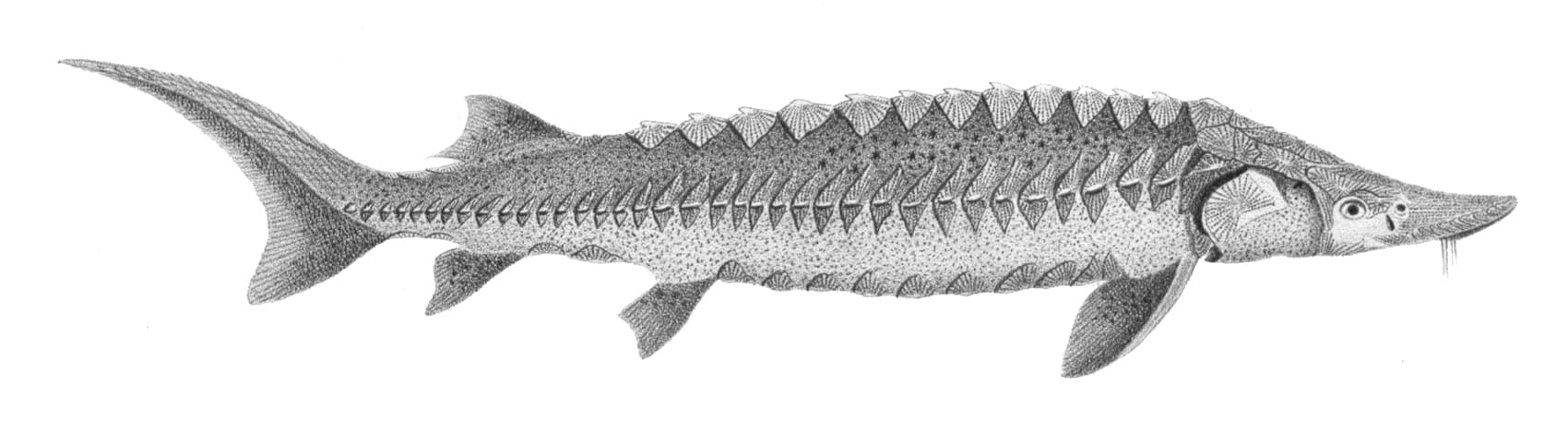
Taxonomy
- Kingdom
- Animalia
- Phylum
- Chordata
- Class
- Actinopterygii
- Order
- Anguilliformes
- Family
- Acipenseridae
- Genus
- Acipenser
- Species
- fulvescens
Habitat
Lake sturgeons inhabit large rivers, lakes, and their connecting waters in North America, preferring deep, cool waters with strong currents and substrates like gravel or rock. They are commonly found in the Great Lakes, Hudson Bay, and Mississippi River basins, often in areas with good water quality and flow. These fish migrate between rivers and lakes, especially for spawning.
Diet
Lake sturgeons are bottom-feeders that primarily consume insects, mollusks, crustaceans, and small fish, using their barbels to detect prey on the riverbed. They feed mainly at night or in low-light conditions, scavenging along the substrate in deeper waters. Their diet varies by age and location, with juveniles eating more small invertebrates and adults targeting larger prey.
Behavior
Lake sturgeons are generally solitary but may form loose schools during migration or feeding. They are primarily nocturnal, spending much of the day resting on the bottom and becoming active at night to feed. These fish exhibit migratory behavior, moving upstream in spring for spawning and downstream in other seasons, and they can be territorial around spawning grounds.
Fishing
Lake sturgeon are a highly regarded sport fish in North America's rivers and lakes, providing anglers with an exciting challenge that bolsters conservation through license fees and excise taxes funding habitat restoration. Employ bottom fishing techniques with heavy tackle, including stout rods (8-12 feet long with medium-heavy to heavy action), reels spooled with 50-80 pound test braided line, and large hooks (sizes 5/0 to 10/0) baited with nightcrawlers, cut bait like smelt or fish chunks, or even artificial lures that mimic invertebrates to target their nocturnal feeding habits on the riverbed. The prime season is spring during spawning migrations when water temperatures hit 8-15°C, with evenings and nights offering the best bites in deep, cool waters; focus on areas with strong currents, gravel or rock substrates in the Great Lakes, Hudson Bay, or Mississippi River basins for optimal success. Record sizes include the IGFA all-tackle world record of 168 pounds 0 ounces, caught in Canada, highlighting their impressive growth potential. Special regulations, such as catch-and-release mandates or slot limits in many regions, serve as effective management tools to sustain healthy populations and support stocking programs, ensuring that angler-funded initiatives continue to protect these vital waterways and promote long-term conservation.
Conservation Status
Listed as Least Concern by IUCN.