
Overview
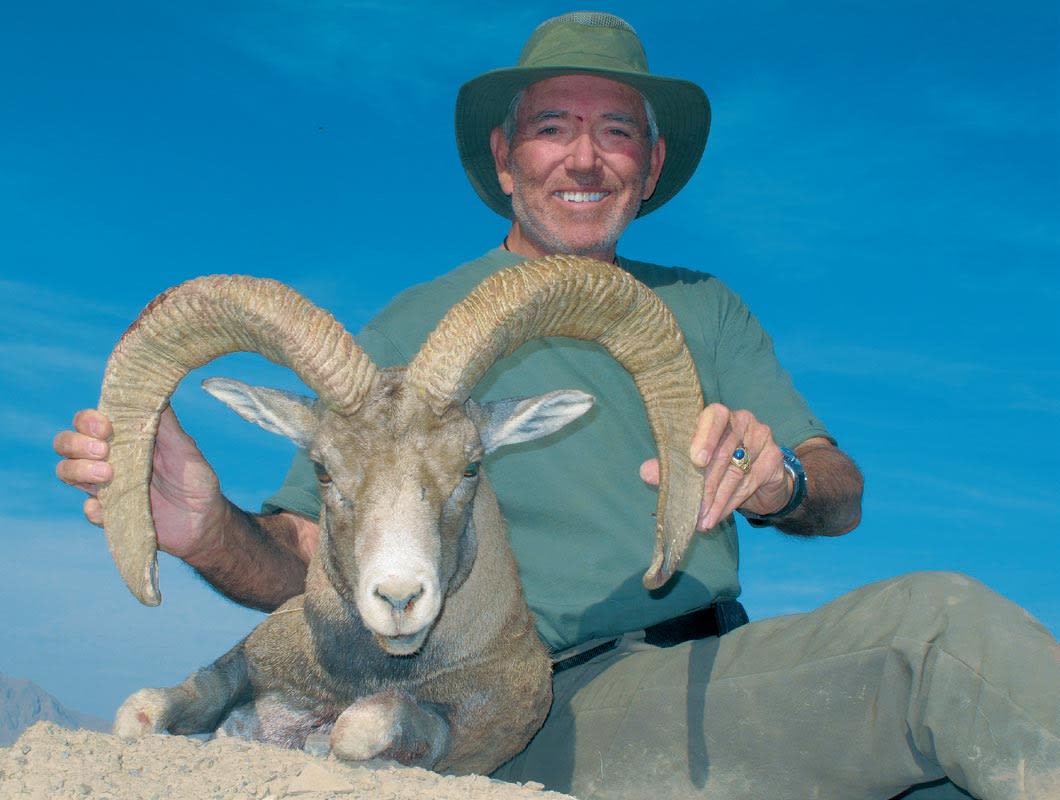
The Kerman sheep is believed to be a hybrid between the Laristan mouflon (O. g. laristanica) and the Blanford urial (O. v. blanfordi), which occurs naturally in the Kerman region of southeastern Iran. It has 54 or 55 chromosomes and produces fertile offspring. Its winter coat is darker than that of the Laristan mouflon, and there is a white saddle patch but no bib. A black neck ruff is present, extending the full length of the neck in some animals but limited to just the lower half in others. The horns are homonymous, showing a flat frontal surface with sharp corners. Even though the scientific name above indicates that this sheep is a hybrid between the Laristan mouflon and the Blanford urial, that is not necessarily accepted by all. The Kerman sheep probably has had a considerable influence over time from the red sheep to the northwest and the Transcaspian and Afghan urials to the northeast. There are continuous mountain corridors which possibly make the Kerman sheep a result of influence from the red sheep to the northwest, the Transcaspian and Afghan urials to the northeast, the Blanford urial to the southeast, and the Laristan mouflon to the south.
Taxonomy
- Kingdom
- Animalia
- Phylum
- Chordata
- Class
- Mammal
- Order
- Artiodactyla
- Family
- Bovidae
- Genus
- Ovis
- Species
- Wild hybrid sheep, Ovis ssp. x Ovis ssp.
Habitat
High altitude regions.
Diet
Primarily grazes but will browse when necessary. Typically feeding in the early morning and evening.
Behavior
They are a gregarious animal and the herds they form are non-territorial. These animals rest during the day under and between rocks and shade trees where they can stay well hidden. Mating season lasts from late November to early December with females giving usually giving birth to one single lamb after a 5-6 month gestation.
Hunting
The season usually run from the first of October to the end of February. Good physical condition is essential for the hunter. Horses may be available in some camps.
Conservation Status
This animal is susceptable to threats of many kinds due to the limited size of its range. Continued protection and research must be provided to ensure the survival of this animal.